Guides & resources
Internal communication plan: a free template for shift teams
How to build an internal communication plan that reaches every shift, including casual staff: which channel for what, an example and a free template (PDF).
Short answer: An internal communication plan is a one-page table that says what you communicate, who to, on which channel, when, who owns it and how you’ll know it landed. On a shift team, sending something isn’t enough, because someone’s always off. Keep the plan to one page, give every item one channel and one owner, and test each line against the person who works the fewest shifts.
On Tuesday morning the returns process changes. Priya, who runs the shop, sends an email, pins a note in the staff room and mentions it at the morning huddle. On Saturday, Tom takes a return the old way. Tom works two shifts a month, has no work email and wasn’t in on Tuesday. The note is behind the rota.
Priya’s shop is made up, but you’ll know it if you run a restaurant, hotel or shop. Want to start now? Download the internal communication plan template (PDF).
What is internal communication on a shift team?
Internal communication is everything you say to, and hear from, the people who work for you. On the floor it runs four ways:
- From you to the team: changed routines, rota changes and what’s on this week.
- From the team to you: questions, ideas, what isn’t working and near misses.
- Between shifts: what lunch hands over to dinner.
- Between sites: the same thing in ten places, see multi-location team communication.
Most advice on the subject assumes an office, where everyone has a laptop, a work email and the same hours. This guide is for teams where none of that’s true.
Why internal communication breaks on the rota
The problem is rarely that nobody said anything. It’s that it was said in five places to half the team.
- Everyone’s never in at once. What’s said at the morning huddle reaches the morning. The evening gets it second-hand, if at all.
- Plenty of your team have no work email. Email works for head office, not for someone on two shifts a month.
- Information lives everywhere. A note, a whiteboard, a WhatsApp group and your head. Nobody knows where to look.
- Word of mouth changes on the way. “I told Anna” isn’t a plan.
- Not everyone reads English best. Ten lines of policy wording won’t reach the whole kitchen.
- You can’t tell what landed. Sending something doesn’t tell you who read it.
Do you legally need an internal communication plan?
We haven’t found a UK law that requires one. What the law does require, under section 2 of the Health and Safety at Work etc. Act 1974, is “the provision of such information, instruction, training and supervision as is necessary” to keep your employees safe, so far as is reasonably practicable. A plan is how you show yourself that a changed safety routine reached the weekend team.
If you’re outside the UK, check your own rules. Our Swedish guide covers Sweden.
How to write an internal communication plan in five steps
- List everything that goes out in a normal week. Look back at two weeks of emails, notes and chats.
- Sort it by urgency and importance. Urgent, must read, good to know or conversation.
- Give every item one channel. If the same routine is in the email, on the note and in the chat, nobody knows which one’s current.
- Give every line an owner. Write a role, not a name, so the plan survives someone leaving.
- Decide how you’ll know it landed. A confirmation, a reply or a question at the next handover.
Then test it on Tom: how does someone on two shifts a month find out? If you’ve got no answer, the line isn’t finished.
Which channel for which message?
| What it is | Example | Channel |
|---|---|---|
| Urgent | Fire, threat, burst pipe | Call. 999 first if anyone’s life or health is at risk |
| Must read | Changed routine, allergens, safety | In writing with a confirmation, plus two minutes at the next handover |
| Rota and shifts | Swapped shift, new start time | The rota system you already use |
| Good to know | This week’s news, new starters | A feed or noticeboard, grouped once a week |
| Routine questions | “How do we handle returns?” | The employee handbook first, then your site’s channel |
| Handover | What the evening needs to know | A short note, and in person if the shifts overlap |
| Conversation | Safety, ideas | Staff meeting |
| Personal | Pay, health, conflict | One to one, or a one-to-one meeting, never in the group |
Keep anything that must be read to three lines: what’s changing, from when and who to ask. For example: “From Monday, returns without a receipt go to the shop manager. Applies to all shifts. Questions to Priya.” Use plain words and one idea per sentence, and more of the team will read it.
Internal communication plan template
The template is a free two-page PDF: download the internal communication plan template (PDF). Page one is the plan, with the example below filled in and blank rows for your own. Page two covers who calls who when it’s urgent, which channels you use and what you’ve changed.
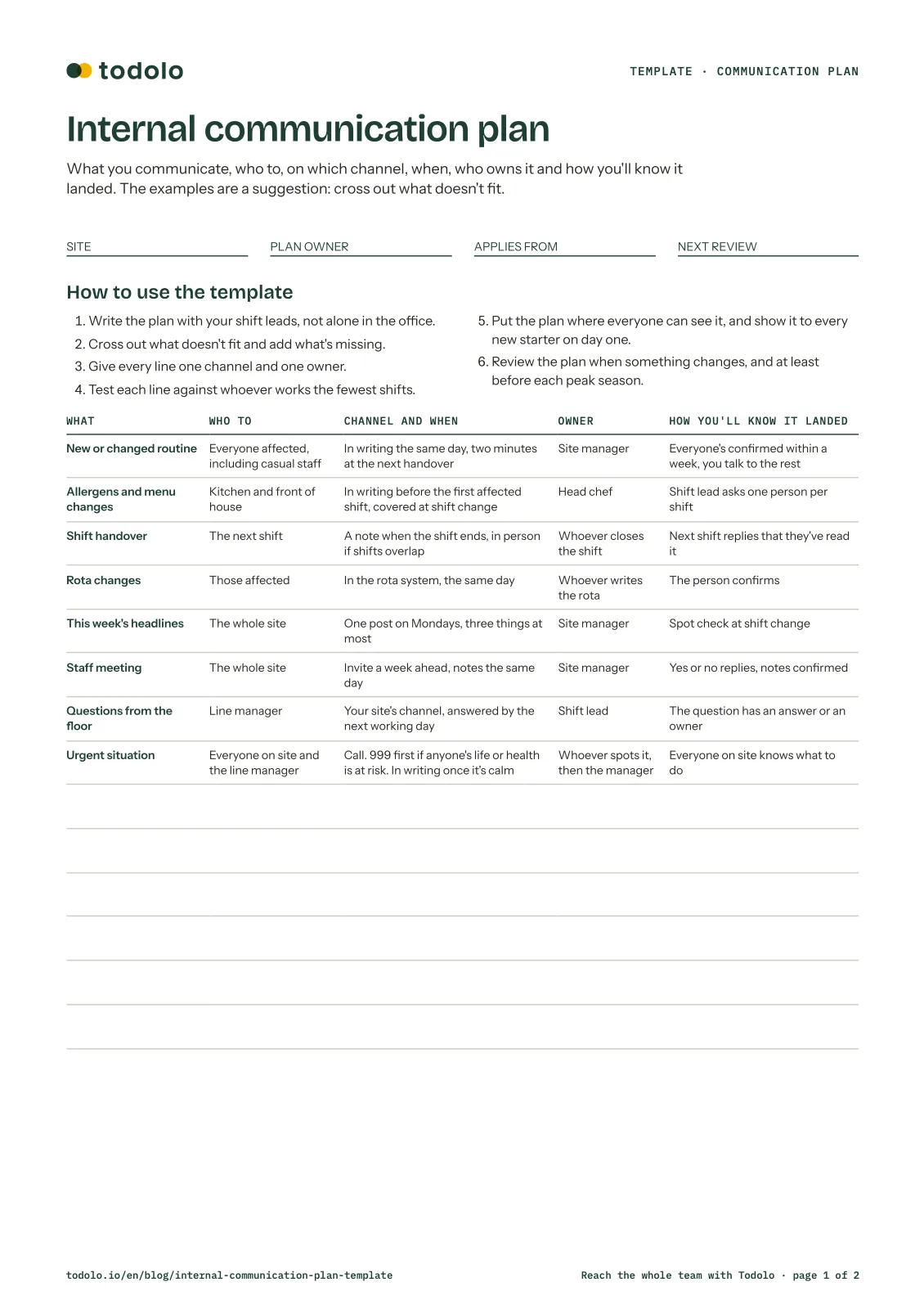
How to use the template
- Write the plan with your shift leads, not alone in the office.
- Cross out what doesn’t fit and add what’s missing.
- Give every line one channel and one owner.
- Test each line against whoever works the fewest shifts.
- Put the plan where everyone can see it, and show it to every new starter on day one.
- Review the plan when something changes, and at least before each peak season.
Example plan for one site
| What | Who to | Channel and when | Owner | How you’ll know it landed |
|---|---|---|---|---|
| New or changed routine | Everyone affected, including casual staff | In writing the same day, two minutes at the next handover | Site manager | Everyone’s confirmed within a week, you talk to the rest |
| Allergens and menu changes | Kitchen and front of house | In writing before the first affected shift, covered at shift change | Head chef | Shift lead asks one person per shift |
| Shift handover | The next shift | A note when the shift ends, in person if shifts overlap | Whoever closes the shift | Next shift replies that they’ve read it |
| Rota changes | Those affected | In the rota system, the same day | Whoever writes the rota | The person confirms |
| This week’s headlines | The whole site | One post on Mondays, three things at most | Site manager | Spot check at shift change |
| Staff meeting | The whole site | Invite a week ahead, notes the same day | Site manager | Yes or no replies, notes confirmed |
| Questions from the floor | Line manager | Your site’s channel, answered by the next working day | Shift lead | The question has an answer or an owner |
| Urgent situation | Everyone on site and the line manager | Call. 999 first if anyone’s life or health is at risk. In writing once it’s calm | Whoever spots it, then the manager | Everyone on site knows what to do |
This is our suggestion, not a standard. Change whatever doesn’t fit.
Examples from restaurants, hotels and shops
- In a restaurant: a new allergen on the menu has to reach kitchen and front of house before the first guest. That’s a must-read line, not something you mention in passing.
- In a hotel: nights need to know what days promised the guests. Give handover its own line, and read more on internal communication in hotels.
- In a shop: peak season temps start after everything’s been said. Keep the plan, the till routine and who to ask in one place.
- Across sites: give every site manager the same frame and let them fill in their own lines. Send central news to managers first, so they can answer the questions.
How to tell if it’s working
- Track confirmations by site. Who hasn’t read the changed routine after a week? Talk to them, and find out why.
- Spot check. Ask two people on the evening shift what the new routine is. A confirmation shows someone read it, not that they understood it.
- Ask the team. Add a line to your pulse survey: “I get the information I need to do my job.”
Your communication plan in Todolo
You can run this plan with notes and conversations. The hard part is keeping it going when the team’s spread across shifts, and that’s where Todolo fits. Todolo is one app for the whole shift: news, chat, training, checklists and handbooks in an employee app that needs no computer or company email address.
Here’s how the plan’s lines work in Todolo Communications:
- Must read becomes a post targeted by role and site, with read confirmation, so you see who’s confirmed. Write it ahead, publish it on the right day and pin what needs to stay at the top.
- Questions and handovers go in your site’s channel. Channels follow site and role, and every message can be read in each person’s own language.
- Routine questions can go to TOD, Todolo’s AI teammate, which answers from your own handbooks.
- Meetings become events with RSVP.
- Rota and payroll stay where they are. Todolo connects to the systems you already use.
ESS Group runs Todolo for more than 3,000 people in its hotels and restaurants, in five languages.
Todolo won’t write the plan for you, and if there’s a fire you still call. A read confirmation shows who read the post, and the conversation about why the routine changed is still yours.
Common questions about internal communication plans
What should an internal communication plan include?
What you communicate, who to, on which channel, when, who owns it and how you’ll know it landed. A project plan also needs goals, audiences and a budget.
What’s the difference between a communication plan and a strategy?
A strategy says why you communicate and what you want to achieve over time. A plan says who does what and when. A single site can go a long way on the plan alone.
Who owns internal communication?
The employer, and day to day the line manager. In bigger companies HR or a comms team often owns the frame, but the site manager makes sure it lands. Put one owner on every line.
Is a WhatsApp group enough?
For quick questions it can be. Anything that must be read soon gets buried, and it’s hard to find again. Read more on work WhatsApp groups.
How often should you update staff?
There’s no rule. We suggest sending must-reads straight away, grouping the rest into one post a week and holding a short staff meeting once a month.
Start with this week’s notes
Count every note, whiteboard, email list and group chat on your site. Then bring the template to your next shift change and fill in the first three lines with your shift leads. Start with the routine that was missed most recently. Tom’s your test.
In thirty minutes we’ll show you how your plan would look in Todolo, site by site. There’s no long contract to sign, and there’s a 30-day money-back guarantee.