Guides & resources
HACCP plan: the 7 principles, a free template and when to review it
Write a HACCP plan your restaurant will use: the 7 principles, example limits in °C and °F, when to review it, and a free HACCP plan template (PDF).
Short answer: HACCP stands for Hazard Analysis and Critical Control Point. It’s a preventive food safety system: you find the steps where food could become unsafe, set a limit at the ones that matter most, check those limits, act when one is missed, and keep records that show it all works. A HACCP plan is that system written down.
It’s 11:20. Priya probes the first tray of roast chicken, checks the reading against the limit on the log and initials it. Knowing that limit, and what to do when a reading falls short, is the heart of a HACCP plan.
This guide is for whoever runs a restaurant, café or catering kitchen, or several of them. Keep the free HACCP plan template (PDF) open while you read.
What is HACCP?
HACCP (Hazard Analysis and Critical Control Point) is a way of keeping food safe by prevention. Instead of testing the finished dish, you work out where your process could go wrong and control those points while the food is being made. The FAO/WHO Codex Alimentarius, in its General Principles of Food Hygiene, defines a HACCP system as developing a HACCP plan and then carrying out the procedures it sets out.
That Codex text (CXC 1-1969, last revised in 2022) is the international reference. Good hygiene practices come first in it, as “the foundation of any effective control of hazards”, and HACCP sits on top.
A hazard, as Codex defines it, is a biological, chemical or physical agent in food that could harm someone’s health. Our template lists allergens separately, as a fourth type. For which allergens are in each dish, keep an allergen matrix.
Pillsbury developed HACCP in the 1960s with NASA and US Army laboratories to keep astronaut food safe.
What is a critical control point?
A critical control point (CCP) is a step where a control is essential to keep a significant hazard in check. Each one gets a critical limit: a measurable or observable line between safe and unsafe food.
In a restaurant, the usual candidates are cooking, cooling, reheating and hot holding. Cleaning, pest control, personal hygiene, supplier checks and training are prerequisite programmes, the base the plan stands on. In a voluntary system, the US Food and Drug Administration (FDA) says refrigeration and cooling may be handled as standard operating procedures rather than CCPs, and 2022 European Commission guidance says frying or grilling in a restaurant “might not be a CCP”. Your hazard analysis decides.
The 7 HACCP principles (in plain terms)
Codex sets out the seven principles, EU and UK law lists them in Article 5 of Regulation (EC) 852/2004, and the FDA’s HACCP principles and application guidelines use slightly older wording. Here they are in Codex’s wording, shortened, following one dish: roast chicken.
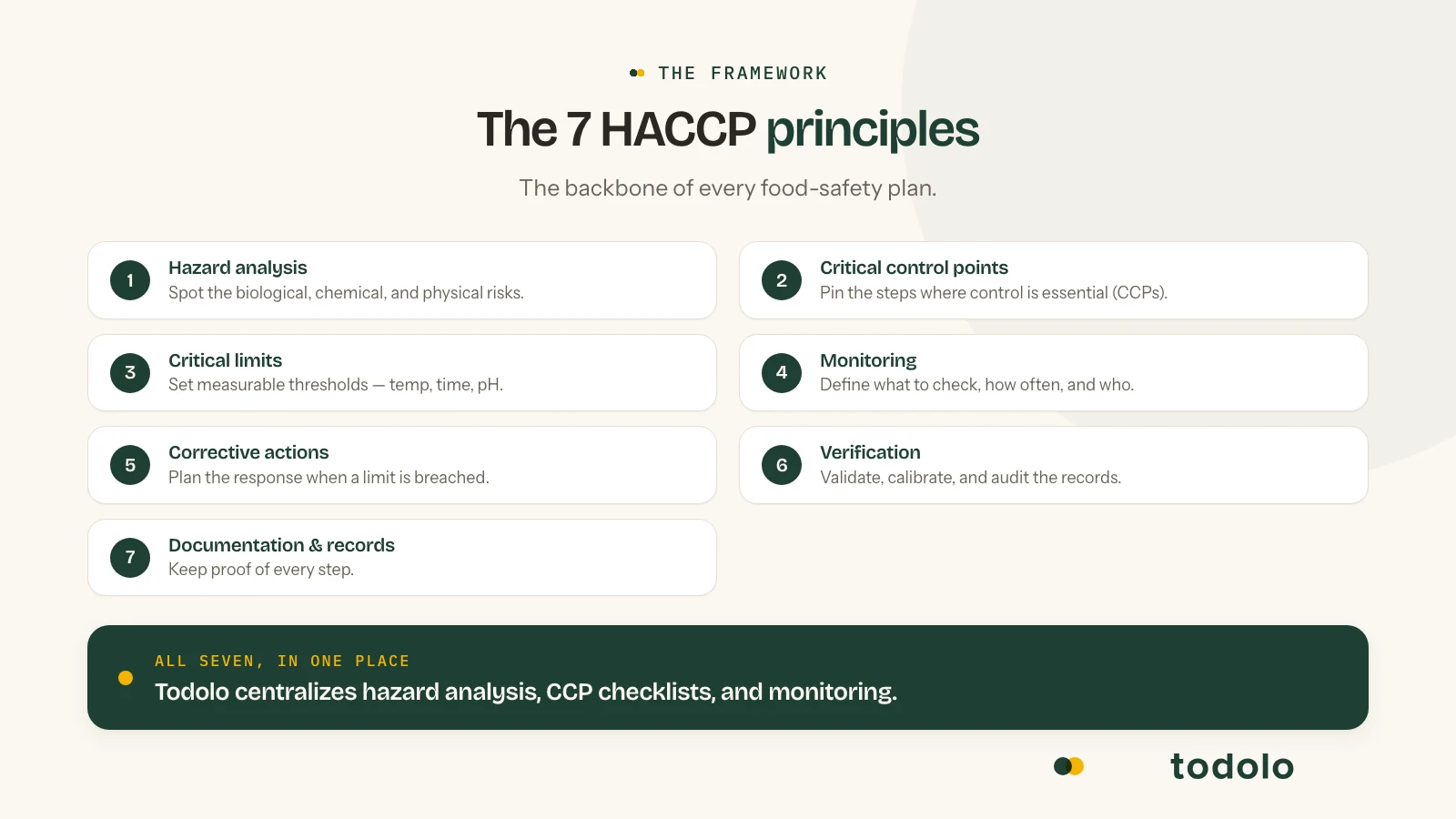
The 7 principles of HACCP are:
- Conduct a hazard analysis and identify control measures. List what could go wrong at each step and pick out the significant hazards: reasonably likely, and serious enough to need control. For the chicken: bacteria surviving undercooking, or spreading from raw chicken to salad on a shared board.
- Determine the critical control points. Find the step where control of each significant hazard is essential. For the chicken: cooking, because it kills the bacteria and no later step would.
- Establish validated critical limits. The line between safe and unsafe, backed by evidence: in a kitchen, usually a limit from your food safety authority. For the chicken: 74 °C (165 °F) in the US FDA Food Code; 70 °C (158 °F) for 2 minutes, or 75 °C (167 °F) for 30 seconds, in advice from the UK’s Food Standards Agency (FSA).
- Establish a system to monitor control of CCPs. What’s checked, how, when and by whom, often enough to catch a problem before food reaches a guest. For the chicken: the cook probes the thickest piece in each tray and logs the reading, the time and their initials.
- Establish corrective actions. Decide in advance what happens to the food, how you fix the cause and who records it. For the chicken: back in the oven, then probe again.
- Validate the plan and establish verification. Validation asks whether the plan can work. Verification checks that it does, and Codex says it should be done by someone other than the person who monitors and takes corrective action. For the chicken: the head chef reads the week’s log, and the probe gets a monthly check, as Scotland’s CookSafe guide suggests.
- Establish documentation and records. Keep the plan and records in proportion to “the nature and size of the food business”, as EU and UK law puts it. For the chicken: the cooking log, plus a note when a tray needed longer.
How to write a HACCP plan, step by step
Codex sets out implementation as the 12 steps of HACCP: five preliminary tasks, then the seven principles.
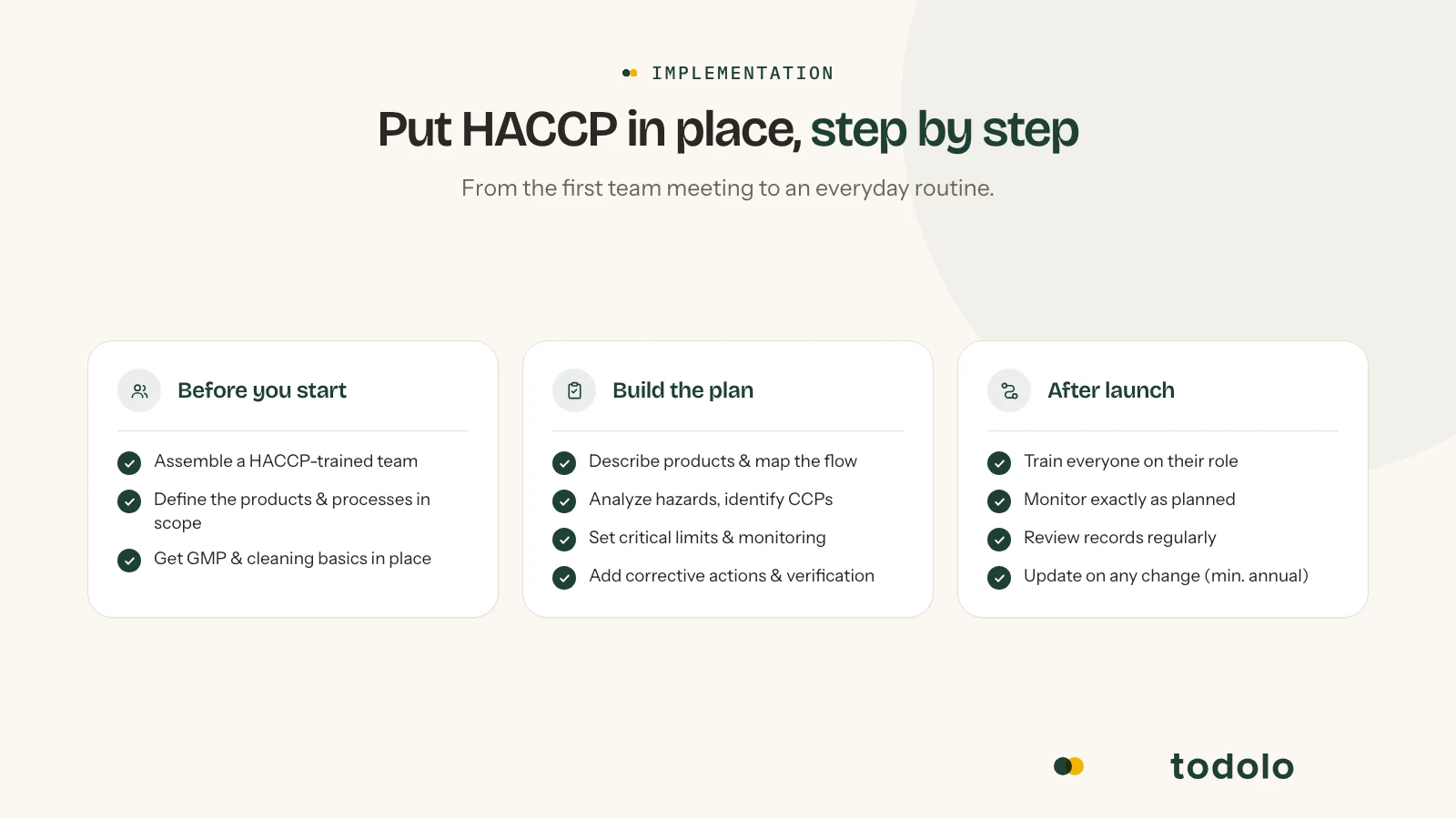
Before you start, check your prerequisite programmes are running, from cleaning to supplier checks: Codex says HACCP “will not be effective” without them. Then form the team and build the plan:
- Assemble the HACCP team: people who know the food, led by someone trained in HACCP.
- Describe the food: ingredients, storage and how long it keeps.
- Identify the intended use: who eats it, including higher-risk groups such as young children, older people or anyone with an allergy.
- Draw the flow diagram: a simple flow chart of every step from delivery to the plate.
- Confirm it on site: walk the kitchen during service and correct the diagram.
- Analyse the hazards (principle 1).
- Determine the CCPs (principle 2).
- Set the critical limits (principle 3).
- Set up monitoring (principle 4).
- Write the corrective actions (principle 5).
- Validate and verify (principle 6).
- Keep documents and records (principle 7).
After launch, train everyone on their part: the cook needs the limit and the corrective action, not the whole plan. Then monitor, read the records and review.
What goes in a HACCP plan
Codex defines a HACCP plan as the documents that keep your significant hazards under control. Our template has seven parts:
- business details and review dates
- the HACCP team
- product and process, with allergens
- the flow diagram, checked on site
- the hazard analysis
- the CCP plan
- the review log
A HACCP plan for restaurants
A restaurant isn’t a food factory. The menu changes, the team changes, and whoever monitors a CCP is also cooking.
Group your menu by process, not by dish
A plan written dish by dish is out of date when the specials change. The FDA’s Managing Food Safety manuals group menu items into three processes, by how often food passes through the danger zone between 5 and 57 °C (41 and 135 °F):
- No cook step: salads, sandwiches, sliced fruit.
- Same-day service: cooked and served, or hot held, on the same day, like the lunchtime chicken.
- Complex preparation: cooked, cooled, reheated and hot held, like a curry made the day before.
Each process gets its controls once. A new dish joins the process it fits and takes on its controls.
Write monitoring for the person on shift
Every monitoring line answers what, how, when and who, in words someone on their first shift could follow mid-rush. “Probe the thickest piece in each tray and log the reading” works. “Monitor cooking temperatures” doesn’t.
Write corrective actions as short steps that say who decides what happens to the food: a standard operating procedure in all but name.
Fridge, delivery and cleaning checks usually sit in your opening and closing checklists. Keep the plan where staff look for answers mid-shift, next to the staff handbook, not in an office binder.
One plan per site, or one for the group?
Write a shared base for the group: the same processes, limits and forms. Then give each site its own flow diagram and hazard analysis wherever the kitchens differ: one has a blast chiller, say, and the other doesn’t. Codex says a generic plan “should be tailored to the food operation”. More on running several restaurants to one standard.
HACCP plan template
The free template is an A4 landscape PDF with all seven parts and no sign-up. You can download the HACCP plan template (PDF) and print it.
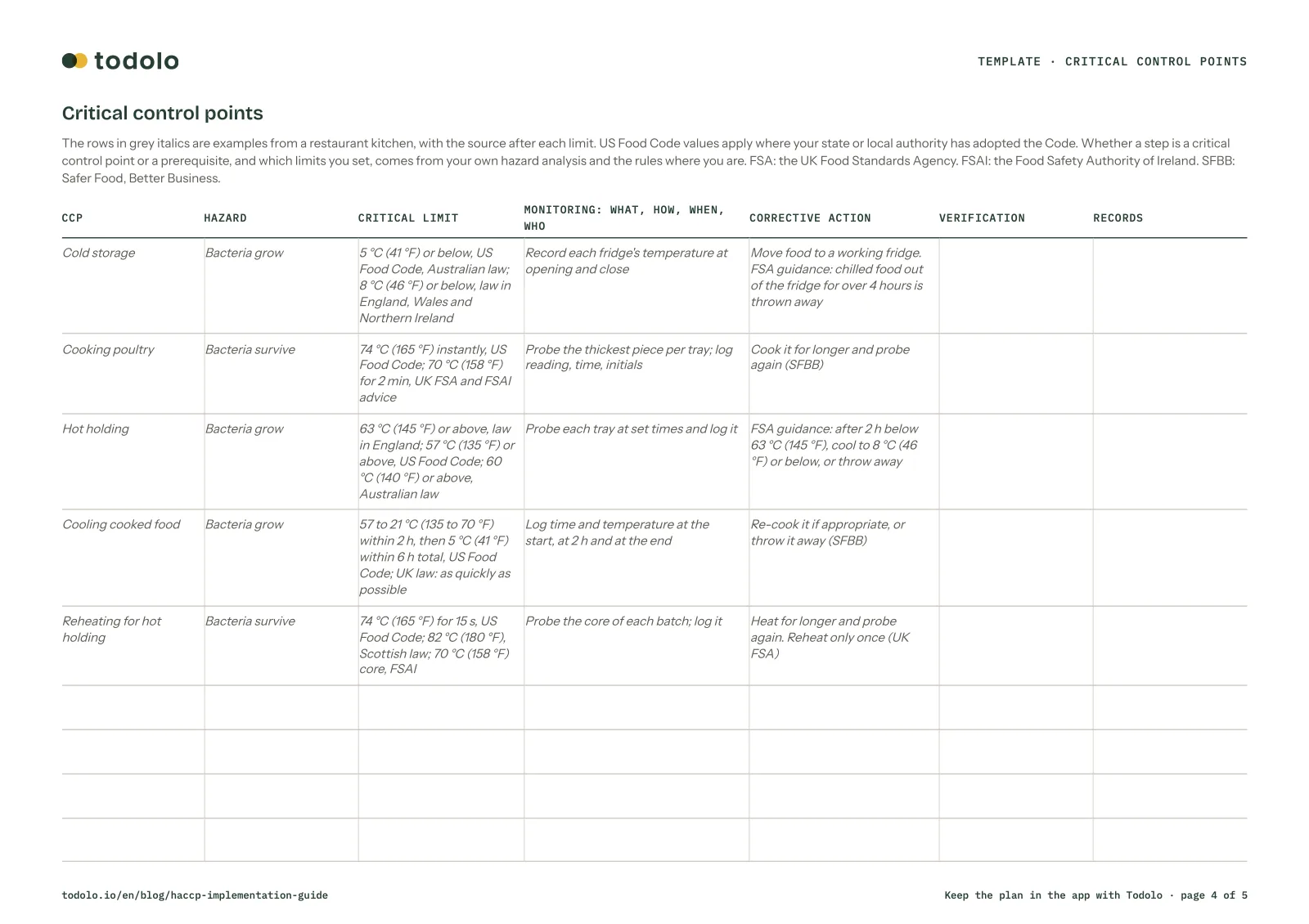
Below the steps is a HACCP plan example for a restaurant kitchen, which the template’s CCP page carries in grey. In the table, FSAI is the Food Safety Authority of Ireland and SFBB is Safer Food, Better Business, the FSA’s pack for small caterers.
How to fill in the plan
- Fill in the business, site and HACCP lead, then date the plan and name the team.
- Describe your food and who eats it, including allergens and anyone at higher risk.
- Draw every step from delivery to service, then walk the kitchen and correct the diagram.
- For each step, list the hazards, rate likelihood and severity, and mark which steps are CCPs.
- For each CCP, write down the limit, the monitoring, the corrective action and the records.
- Sign the review log each time you review the plan, and set the next review date.
Example control points and limits in a restaurant kitchen
| Step | Hazard | Critical limit | Monitoring | Corrective action |
|---|---|---|---|---|
| Cold storage | Bacteria grow | 5 °C (41 °F) or below, US Food Code, Australian law; 8 °C (46 °F) or below, law in England, Wales and Northern Ireland | Record each fridge’s temperature at opening and close | Move food to a working fridge. FSA guidance: chilled food out of the fridge for over 4 hours is thrown away |
| Cooking poultry | Bacteria survive | 74 °C (165 °F) instantly, US Food Code; 70 °C (158 °F) for 2 min, UK FSA and FSAI advice | Probe the thickest piece per tray; log reading, time, initials | Cook it for longer and probe again (SFBB) |
| Hot holding | Bacteria grow | 63 °C (145 °F) or above, law in England; 57 °C (135 °F) or above, US Food Code; 60 °C (140 °F) or above, Australian law | Probe each tray at set times and log it | FSA guidance: after 2 h below 63 °C (145 °F), cool to 8 °C (46 °F) or below, or throw away |
| Cooling cooked food | Bacteria grow | 57 to 21 °C (135 to 70 °F) within 2 h, then 5 °C (41 °F) within 6 h total, US Food Code; UK law: as quickly as possible | Log time and temperature at the start, at 2 h and at the end | Re-cook it if appropriate, or throw it away (SFBB) |
| Reheating for hot holding | Bacteria survive | 74 °C (165 °F) for 15 s, US Food Code; 82 °C (180 °F), Scottish law; 70 °C (158 °F) core, FSAI | Probe the core of each batch; log it | Heat for longer and probe again. Reheat only once (UK FSA) |
These rows are examples, not your plan. Your own hazard analysis and the rules where you are decide which steps are CCPs and what the limits are, and Food Code figures apply only where your state or local authority has adopted the Code.
How often should a HACCP plan be reviewed?
Review your HACCP plan whenever something changes, and at least once a year. Change is the trigger in UK and EU law (Article 5(2)). The FSA’s MyHACCP guidance calls a yearly review the absolute minimum, and it’s law for US meat, poultry, seafood and juice HACCP plans, and for Australian food safety programs where a state or territory requires one.
MyHACCP is written for small manufacturers. Codex, the international guidance, says to review “periodically and whenever there is a significant change”. Small UK caterers on SFBB do a diary review every four weeks, and CookSafe in Scotland records checks every six months.
When should a HACCP plan be reviewed?
Review the plan, or the steps affected, when:
- a dish, recipe or supplier changes
- equipment, the layout or the way you work changes
- a complaint, suspected food poisoning or a recall involves your food
- the same limit is missed again (EU guidance says repeated corrective actions mean a review)
- an inspection finds a problem
- a key person changes, such as the head chef
- the law changes, such as a US state adopting the 2026 Food Code
How to run a HACCP plan review
Sit down with the HACCP lead and someone who works the line:
- Walk the kitchen with the flow diagram and check each step still matches.
- Read the records since the last review, looking for repeated misses and skipped checks.
- Ask whether each limit and check still fits the food, the equipment and the rules.
- Make sure training is up to date and every probe has had its regular check.
- Fill in the review log on the template’s last page and set the next date.
Is HACCP a legal requirement?
It depends where you are. In the UK and Ireland, almost every food business, restaurants included, must have procedures based on the HACCP principles. Elsewhere it’s narrower: a US restaurant needs a HACCP plan only for special processes, an Australian one needs a food safety program only where its state or territory requires one, and Canadian restaurants follow provincial and territorial rules.
This is a summary, not legal advice.
UK. In Great Britain, every food business except primary producers, such as farms, must keep “a permanent procedure or procedures based on the HACCP principles”. That’s Article 5 of Regulation (EC) 852/2004, which still applies there as assimilated law. The FSA’s guidance on GOV.UK, which covers Northern Ireland too, says your food safety management system must meet the HACCP principles. Small caterers can follow SFBB, Safe Catering in Northern Ireland or CookSafe in Scotland.
Ireland. The same EU regulation applies, and the FSAI says a HACCP-based food safety management system has been a legal requirement for all food businesses since 1998. For guidance, its HACCP FAQ says to review your system “from time to time”.
US. Federal law requires HACCP plans for meat, poultry, seafood and juice processing, not restaurants. The FDA Food Code is a model code that applies only where a state or local authority adopts it, and its preface says it is “neither federal law nor federal regulation”. It asks for a HACCP plan only for variances and special processes such as curing, reduced oxygen packaging or sprouting seeds (§ 8-201.13). The 2026 edition adds § 8-201.15: a written food safety management system, including procedures, training plans and monitoring records, due within four years of your regulator adopting the Code. That isn’t a HACCP plan, and regulators can exempt minimal-risk establishments.
Australia. Since 8 December 2023, Standard 3.2.2A has put a caterer or food service business in category one when it turns unpackaged potentially hazardous food into ready-to-eat food that is still potentially hazardous. It names restaurants as caterers. Category one businesses need a certified food safety supervisor, food handlers with food safety training or matching skills and knowledge, and records that back up key controls, kept for three months unless the business can satisfy an authorised officer another way. None of that is a HACCP plan. A HACCP-based food safety program applies where your state or territory requires one, and in settings such as hospitals and aged care.
Canada. Restaurants selling to consumers fall outside federal licensing, so provincial or territorial rules apply. Under the Safe Food for Canadians Regulations, most licence holders must keep a written preventive control plan with CCPs, critical limits, monitoring and corrective actions. Those with food sales of $100,000 or less need one only for certain foods, such as meat, fish, dairy and eggs.
Keeping the HACCP plan alive across several kitchens
At 12:45 on a Saturday, nobody is reading the plan. It lives in what the cook on the grill knows, what the shift lead checks, and whether the warm fridge someone noticed gets reported and followed up. Across ten kitchens, can you see that happening without calling every site? Todolo is one app for the whole shift: team communication with translation, training, handbooks with TOD, and the day’s routines, deviations and workflows in Todolo Operations. For a HACCP plan, that means:
- Answers on shift. Import your plan from Word or PDF as a handbook. TOD, Todolo’s AI teammate, answers “the chicken’s under the limit, what now?” from it and points to the source.
- Changes that reach everyone. Post a changed limit once: each person reads it in their own language, and you see who confirmed it. Courses and quizzes show who has completed what.
- One standard at every site. The same routines everywhere, each with a deadline, showing as overdue if nobody does them. Copy the setup to a new site and it starts on your standard.
- Readings in the task. Temperature and photo answers, stored with who completed the task and when.
- Deviations where they’re found. Raised from the checklist item with a photo, a severity, an owner and a due date, with the follow-up kept on the case.
- For the review. Each site’s status day by day, and the history as a PDF for one site, a group or the whole organisation.
Todolo helps your team do the checks and shows you they’re done. It doesn’t write your hazard analysis or set your limits: the plan, and the responsibility for food safety, stay with your business.
In thirty minutes we’ll show you how your own HACCP checks would look in Todolo, kitchen by kitchen. There’s no long contract, and you get a 30-day money-back guarantee.
Common questions about HACCP plans
Do you need a HACCP certificate?
Not as a general legal rule in the UK or Ireland, or for US restaurants. EU and UK law asks for adequate HACCP training, which EU guidance says needn’t be a formal course. Where the US Food Code applies, the person in charge must be a certified food protection manager, and Australian category one and two businesses need a certified food safety supervisor. Neither is a HACCP certificate. See also training that sticks on a busy floor.
Who should be on the HACCP team in a small kitchen?
The people who know the food and the kitchen: usually the head chef as lead, a senior cook from each shift and whoever takes deliveries. The lead needs adequate HACCP training, which EU guidance says can be a course, on-the-job training, guides to good practice or advice from your authority. In a very small kitchen, the team might be the owner and one cook.
Is Safer Food, Better Business a HACCP plan?
Not in the classic table format, but it does the same job for small caterers. The FSA describes SFBB as a food safety management system based on the HACCP principles, without the jargon. Its diary includes a review every four weeks. Your local authority might advise a full HACCP plan if your business is larger or higher-risk. See your options on GOV.UK.
What happens when a critical limit is missed?
Follow the corrective action in your plan, there and then. It covers three things. The food: cook it longer, re-cook it or throw it away. The cause: an oven running cool, say, or an overloaded blast chiller. And the record: what happened, what you did and who decided. If it happens again, review that step.
How long should you keep HACCP records?
EU and UK law sets no fixed period: Article 5(4)(c) asks you to retain records “for an appropriate period”, and Article 5(2) asks for records in proportion to the nature and size of your business. Australia’s Standard 3.2.2A sets three months for category one records, and the US Food Code sets 90 days for records of freezing fish to be served raw. If you’re unsure, ask your local authority or regulator.
What’s the difference between HACCP and ISO 22000?
HACCP is the method: seven principles for controlling significant hazards, resting on good hygiene practices. ISO 22000:2018 is a wider, voluntary certification standard for the whole food safety management system, open to any organisation in the food chain. FSSC 22000, which builds on it, and BRCGS are recognised by the Global Food Safety Initiative and mostly asked of manufacturers and suppliers. None of these certifications is a legal requirement for a restaurant, even where HACCP itself is.
Start with one dish this week
Pick the dish you cook most and follow it from delivery to the plate. Mark the step where a missed limit could make someone ill, then fill in that row on the CCP page of the template: the limit, who checks it, and what happens when it’s missed.