Guides & resources
Allergen matrix template: the 14 allergens for restaurants, cafés and hotels (free PDF)
A free allergen matrix template for restaurants, cafés and hotels: the 14 allergens, where they hide in a kitchen and what to do when a customer asks.
It’s Saturday, twenty to eleven. Priya’s on the till at the café when a dad asks whether the cinnamon bun has nuts in it. His daughter’s allergic. Priya doesn’t think so. But the bakery changed the filling this week, and the new one has almonds in it.
Quick answer: An allergen matrix is a table with your dishes down the side and the 14 allergens across the top, marked wherever an allergen is in the dish. The 14 are celery, cereals containing gluten, crustaceans, eggs, fish, lupin, milk, molluscs, mustard, tree nuts, peanuts, sesame, soya and sulphites. If you serve food that isn’t prepacked, in a restaurant, café or hotel, you need to be able to tell customers which of them are in every item. A matrix is the simplest way to make sure the answer doesn’t depend on who’s on shift.
Priya’s made up, but the question at the till isn’t. This guide covers the 14 allergens and where they hide, what the rules ask for, and how to keep a matrix your team actually uses. If you’d rather start straight away, download the allergen matrix template (PDF).
What is an allergen matrix?
An allergen matrix, sometimes called an allergen chart, is the written record of which allergens are in which dish. Each row is a dish, each column is one of the 14 allergens, and a mark in a box means that allergen is in that dish. A notes column says which cereal or which nut, and where there’s a risk of cross-contact.
It’s the source behind every answer you give. The person on the till reads it when a customer asks, the kitchen updates it when a recipe changes, and the manager checks it before a new menu goes live.
The 14 allergens
These are the 14 allergens food businesses have to declare, listed the way UK allergen charts usually show them. The examples show where each one tends to turn up in a commercial kitchen, but the label on each product is what counts.
- Celery. Celeriac, celery stalks, leaves, seeds and celery salt. Found in stock, soups, sauces and spice mixes.
- Cereals containing gluten. Wheat (including spelt and khorasan wheat), rye, barley and oats. Found in bread, pasta, batter, breadcrumbs, beer and most soy sauces.
- Crustaceans. Prawns, crab, lobster and crayfish. Found in shrimp paste, seafood stock and prawn cocktail.
- Eggs. Found in mayonnaise, aioli, hollandaise, pancakes, fresh pasta and egg wash on pastry.
- Fish. Found in fish sauce, anchovies in Caesar dressing and Worcestershire sauce.
- Lupin. Lupin flour and seeds. Found in some bread, gluten free bakes and plant based products.
- Milk. Including lactose. Butter, cream, cheese, whey and milk powder. Found in sauces, bakes and ready made spice mixes.
- Molluscs. Mussels, oysters, squid and snails. Found in oyster sauce and some Asian sauces.
- Mustard. Found in dressings, marinades, mayonnaise and sausages.
- Tree nuts. Almonds, hazelnuts, walnuts, cashews, pecans, Brazil nuts, pistachios and macadamia nuts. Found in marzipan, praline, granola, dukkah and some pestos.
- Peanuts. Found in peanut butter, groundnut oil, satay and massaman curry.
- Sesame. Found in tahini, hummus, sesame oil, burger buns and dukkah.
- Soya. Found in soy sauce, tofu, edamame, miso and soya lecithin in chocolate and bread.
- Sulphites. Sulphur dioxide and sulphites above 10 mg/kg or 10 mg/litre. Found in wine, dried fruit and some pickles.
The tree nut list is complete. Pine nuts, nutmeg and coconut aren’t on it, and peanuts have their own line. That doesn’t mean you can ignore them: if a customer asks about pine nuts, the answer needs to be just as reliable.
What the rules say
The 14 come from Annex II of the food information regulation (1169/2011), and the same list applies in the UK and the EU. In England, Wales and Northern Ireland, this is what the Food Standards Agency asks of food that isn’t prepacked, like meals in a restaurant, food at a deli counter or a takeaway:
- Every item is covered. You have to provide allergen information for every item that contains any of the 14.
- Written or verbal. You can put it on the menu, a chalkboard or a chart, or give it when someone asks.
- Verbal needs a signpost. If you give it verbally, you must tell customers where they can get it, for example a notice at the till saying “Ask us about allergens”.
- Best practice is written. The FSA’s best practice guidance for non-prepacked food, published in February 2025, recommends that written allergen information is always available, alongside a conversation between staff and the customer. It isn’t law, but an allergen matrix is how most kitchens keep the written side.
Food you pack on site before the customer orders, like sandwiches in the chiller, is prepacked for direct sale. Since October 2021, Natasha’s Law means it needs a full ingredients label with the allergens emphasised. In Scotland, Food Standards Scotland publishes its own guidance and its own allergens matrix.
Allergens are also part of your food safety management. In a HACCP plan they’re one of the hazards you control, and a matrix you keep up to date is an easy way to show you’re on top of them.
Allergen matrix template
The template is a free two page PDF: download the allergen matrix template (PDF). Page one is the matrix itself, with room for fifteen dishes, a column for each of the 14 allergens and one for notes. Page two lists the 14 with examples, the routine for when a customer asks, the wording for your notice and a log of changes.
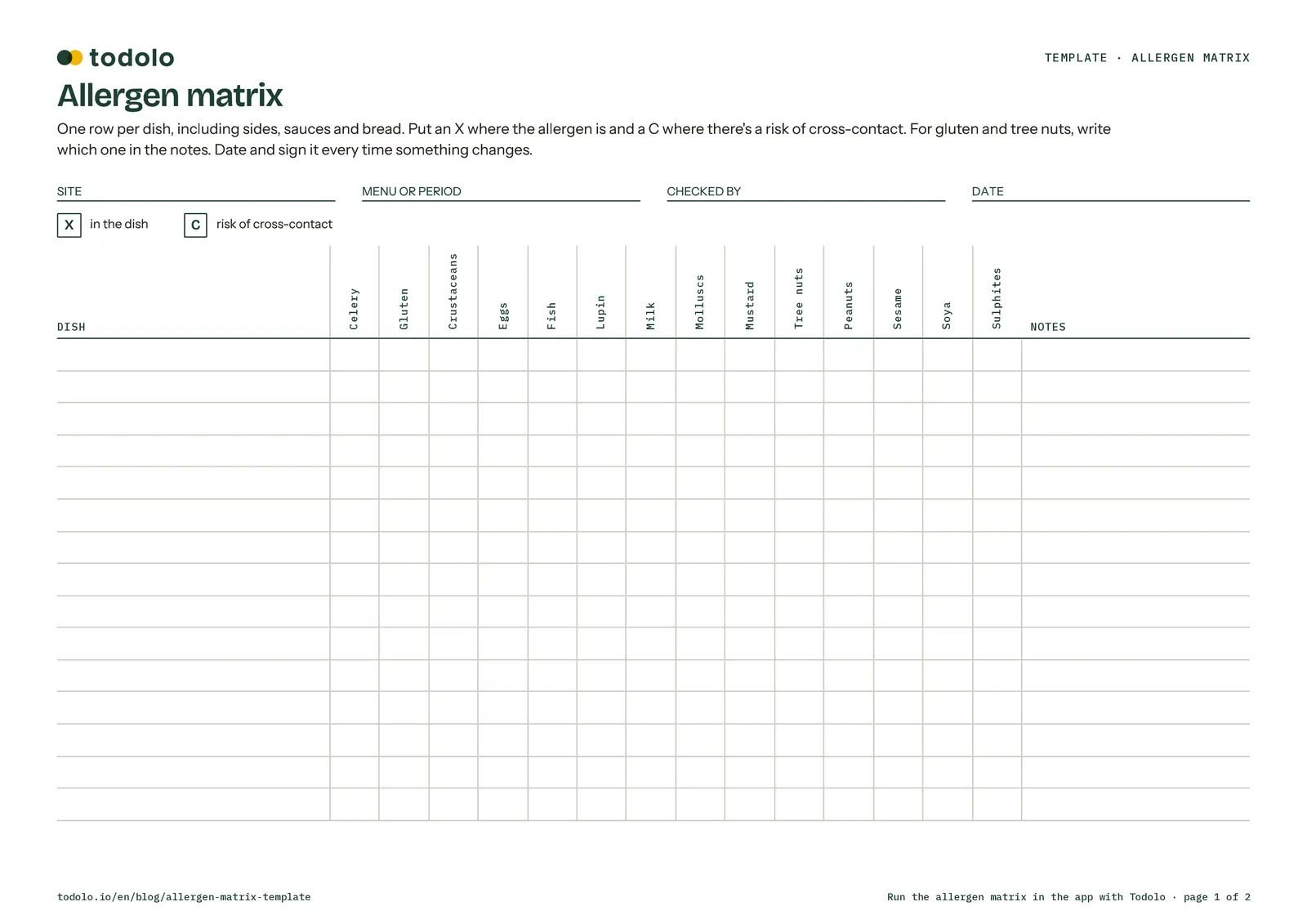
How to fill in the allergen matrix
- One row per dish. Include sides, sauces, dressings and the bread that comes with it. That’s often where the allergen is.
- Work from the recipe and the label. Go through every ingredient and read its label. Stock, ready made sauces and spice mixes have ingredients of their own.
- Put an X where the allergen is. For gluten and tree nuts, write which one in the notes, like wheat or cashew.
- Put a C where there’s a risk of cross-contact. Chips fried in the same oil as battered fish are the classic example.
- Date it and sign it. Whoever checked the matrix writes their name, and the date changes every time something does.
When a customer asks
A matrix only helps if people use it. The routine is in the template too, so it can go up by the till and in the kitchen.
- Ask what they can’t eat. Write it on the order, so the kitchen sees it.
- Check the matrix, not your memory. The dish may have changed since you learned it.
- If you’re not sure, ask the kitchen. Never guess, and it’s better to say you don’t know than that it’ll be fine.
- The kitchen confirms and cooks it separately. Clean utensils, a clean surface and nothing from the fryer unless you know what’s been in it.
- Name the dish when you serve it. Then the customer knows it’s the right plate.
If a customer has trouble breathing or their face starts to swell after eating, call 999.
When something changes
An allergen matrix goes out of date quietly. It’s rarely the menu itself, more often what happens around it:
- A new supplier or a new product. The same item from another wholesaler can have different ingredients.
- The substitute. The usual product’s out of stock, so someone buys something similar instead.
- A new recipe or a seasonal menu. Check the matrix before the first service, not after.
- Specials. They need a row as well, on the same day.
Decide who owns the matrix at each site, usually the head chef, and that nothing new goes into a dish until it’s been checked against the matrix. Then tell everyone on shift what’s changed.
Allergen matrices across several sites
In a group, the same dish is rarely exactly the same dish. One site has a different bread supplier, another has switched mayonnaise. Keep one shared matrix per dish with one owner, and let each site record its differences in the same document. Then there’s only one version that counts, and the new starter at site four reads the same matrix as the one at site one.
Common allergen matrix mistakes
- The matrix exists, but nobody knows where. Whoever’s new on the till tonight should find it in ten seconds.
- The sides are missing. Bread, dressings and garnishes are what gets forgotten.
- “May contain” on everything. Precautionary labelling is voluntary, and it mustn’t mislead. On every dish, it tells the customer nothing.
- Old copies in the folder. Two versions are worse than none, because nobody knows which one is current.
- Seasonal staff get skipped. They’re often the ones on the till on a Saturday in July.
Your allergen matrix in the app with Todolo
Todolo is the one app your team opens for the whole shift, so the allergen matrix can sit next to everything else they use.
- One version that counts. Put the matrix and the routine in Knowledge. When the head chef updates it, everyone sees the latest version, and you can compare revisions to see exactly what changed.
- On their phone. Handbooks are searchable in the mobile app, so the new starter on the till doesn’t have to dig through a folder.
- Changes everyone has read. A post about a new allergen procedure in Communications can ask for a read receipt, and you see who’s confirmed.
- The check before opening. A scheduled checklist in Operations asks every morning whether today’s dishes are in the matrix, with yes or no and a photo.
- Allergens in the induction. In People, new starters do an allergen quiz on their phone before their first shift. Course certificates are internal, not official qualifications.
In thirty minutes we’ll show you how it would look for your sites. There’s no long contract, and you get a 30-day money-back guarantee.
Allergen matrix FAQ
What are the 14 allergens?
Celery, cereals containing gluten, crustaceans, eggs, fish, lupin, milk, molluscs, mustard, tree nuts, peanuts, sesame, soya and sulphites. They’re listed in Annex II of the food information regulation (1169/2011).
Do allergens have to be on the menu?
No. You can give the information verbally, as long as you signpost where customers can get it. What matters is that the information exists for every item and that it’s right.
Is lactose an allergen?
Yes. Milk is on the list, and that includes lactose.
Are pine nuts and coconut tree nuts?
Not on the allergen list. The tree nuts are almonds, hazelnuts, walnuts, cashews, pecans, Brazil nuts, pistachios and macadamia nuts. Peanuts are a separate allergen.
How often should you update an allergen matrix?
Every time a recipe, a supplier or a product changes, and always before a new menu goes live. Go through the whole matrix again when the season changes.
Do we have to say “may contain”?
No. Precautionary allergen labelling is voluntary. Use it where there’s a real risk of cross-contact in your kitchen, and make sure it doesn’t mislead.
Start before the next shift
You don’t have to go through the whole menu tonight. Print the allergen matrix template (PDF), fill in this week’s dishes with the kitchen, and put a notice up by the till: Ask us about allergens.