Guides & resources
Staff induction checklist for restaurants, hotels and shops: from day one to the first month (free PDF)
A staff induction checklist for restaurants, hotels and shops: before day one, the first shift, week and month, and what UK law asks for. Free PDF template.
Short answer: A staff induction is how you get a new starter from accepting the job to working a shift safely on their own. In the UK the core of it is the law: regulation 13 of the Management of Health and Safety at Work Regulations 1999 says you must give adequate health and safety training “on their being recruited”, and food handlers must be supervised and instructed or trained in food hygiene. A good induction runs in four steps: before day one, the first shift, the first week and the first month.
It’s a Friday in March, ten minutes before the doors open. Tom starts his first shift behind the bar of a busy pub. The supervisor who was going to show him round is off sick, the GM is on the floor, and all Tom has is the code for the staff door. He finds the aprons himself. He finds out where the fire exit is in June.
This guide is for GMs and managers in restaurants, pubs, hotels and shops, and the ops and area managers who look after several sites. It covers UK law and isn’t legal advice. Keep the free staff induction checklist (PDF) open while you read.
What is a staff induction?
The induction is the time between someone saying yes and them running their shift without anyone standing next to them. You’ll also hear onboarding, and for most teams it’s the same thing. What separates a good induction from a bad one is rarely how much it covers. It’s whether it’s planned, whether one named person owns it, and whether the new starter knows who to ask.
An induction isn’t the same as training. Training runs for as long as someone works for you, which is what our guide to training that sticks on a busy floor is about. The induction is the start, and it has an end: when the new starter can work safely and on their own.
What does UK law ask for?
No single law is called induction, but several say what a new starter has to know, and when. Most of it sits next to the rest of your health and safety management.
| What | What it means for the induction | Where it comes from |
|---|---|---|
| Health and safety training when they start | Adequate training “on their being recruited”, during working hours | MHSWR 1999, regulation 13 |
| Information on the risks | Clear information on the risks your risk assessment found and what you do about them | MHSWR 1999, regulation 10 |
| Young workers | Before you employ anyone under 18, your risk assessment has to cover the risks to young people | MHSWR 1999, regulations 3 and 19 |
| Food hygiene | Everyone who handles food is supervised and instructed or trained in food hygiene to match their work | Regulation (EC) 852/2004, Annex II, Chapter XII |
| Right to work | You check that they’re allowed to work in the UK before they start | GOV.UK |
| Written statement | Employees and workers get a written statement of their main terms on or before their first day | GOV.UK |
The law asks for adequate training and “comprehensible and relevant” information. It doesn’t ask for a particular form or a set number of hours. Comprehensible is the word to hold on to: a binder to read alone on a quiet afternoon rarely gets you there.
The induction in four steps
Most inductions go wrong because everything is meant to happen on day one. Split it up. A new starter takes in more over four sessions than in one, and you get the chance to see what stuck.
1. Before day one
This is where most of it gets decided, and it takes fifteen minutes. Decide who’ll meet them, and write down a name, not a role. Send a message with the time, the place, the door to use, what to wear and who to ask for. Make sure their account, their shifts and their keys or codes are ready. If you can, put the first shift on a quiet day, not Saturday lunch.
2. The first shift
Start with what keeps the new starter and your guests safe: fire exits, extinguishers, first aid and who to tell when something happens. In the kitchen, hygiene and allergens come before anything else. Then walk through the station or department, and let their buddy show rather than tell. End the shift with five minutes: what wasn’t clear?
3. The first week
Now come the routines you don’t see on day one: opening and closing, food safety checks, the till, working alone and what to do if someone gets aggressive. Show them where the procedures and the staff handbook live, and let them do the tasks themselves with their buddy beside them. Check in briefly at the end of the week.
4. The first month
Book a review before the first week is out. Ask what’s working, what’s missing and what seemed odd. A new starter sees things everyone else stopped noticing long ago. Check the knowledge has stuck, with a quiz or by asking them to show you. When they can work safely on their own, the induction is done. Sign it off.
Staff induction checklist template
The checklist is a free two-page PDF: download the staff induction checklist (PDF). The first page is the points below, with a box to tick, a date and who covered each one. The second page is the first-month review. Cross out what doesn’t apply and add what only you have, like a loading bay or a night porter.
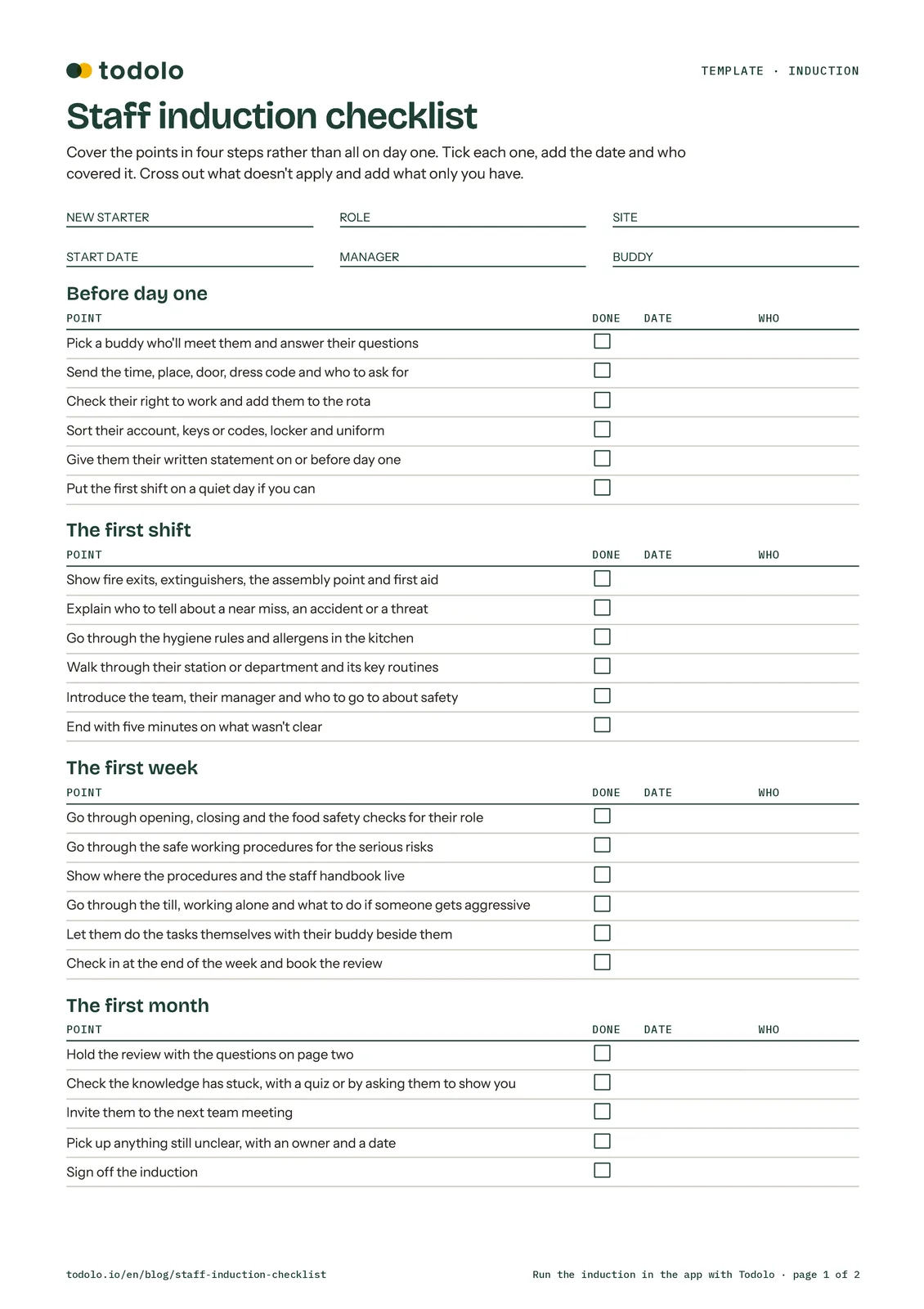
Before day one
- Pick a buddy who’ll meet them and answer their questions
- Send the time, place, door, dress code and who to ask for
- Check their right to work and add them to the rota
- Sort their account, keys or codes, locker and uniform
- Give them their written statement on or before day one
- Put the first shift on a quiet day if you can
The first shift
- Show fire exits, extinguishers, the assembly point and first aid
- Explain who to tell about a near miss, an accident or a threat
- Go through the hygiene rules and allergens in the kitchen
- Walk through their station or department and its key routines
- Introduce the team, their manager and who to go to about safety
- End with five minutes on what wasn’t clear
The first week
- Go through opening, closing and the food safety checks for their role
- Go through the safe working procedures for the serious risks
- Show where the procedures and the staff handbook live
- Go through the till, working alone and what to do if someone gets aggressive
- Let them do the tasks themselves with their buddy beside them
- Check in at the end of the week and book the review
The first month
- Hold the review with the questions on page two
- Check the knowledge has stuck, with a quiz or by asking them to show you
- Invite them to the next team meeting
- Pick up anything still unclear, with an owner and a date
- Sign off the induction
First-month review
The review takes fifteen minutes and is about the induction, not pay or targets. Those belong in a one-to-one. The questions are in the template too.
- Do you know what needs doing on your shift, and where to find the procedures?
- Do you know who to go to if something happens?
- Is there anything in the job that feels unsafe or risky?
- What’s been hardest to learn, and what did you miss?
- What seems odd about how we do things, that we should change?
- Is there anything you’d like to go through again, and with whom?
Inducting casual and seasonal staff
The duty to train covers everyone you employ, however few hours they work. The casual who does two Saturdays a month needs to know where the fire exit is as much as your full-timer does. What changes is the pace, so prioritise:
- Before their first shift: fire exits, extinguishers, who to ask and, in the kitchen, hygiene and allergens.
- In the first week: the rest of the checklist, as their shifts allow.
- Under 18s: cover the risks to young people in your risk assessment before they start, and make sure they’re never left alone with work they shouldn’t be doing.
Seasonal staff need their induction before the season starts, not halfway through it. In our health and safety year plan it sits in May, so plan it in March. If you hire a lot of people at once, do the shared part as a group and the site part on site.
One induction across every site
In a group, the temptation is to let each site do what it’s always done. You end up with as many inductions as managers. Split it instead:
- What’s the same everywhere you write once: the procedures, the staff handbook, hygiene and allergens, the till and how to report a near miss.
- What only exists at one address the site does itself: the fire exits, the building, the team and who to go to about safety.
- Track the same thing everywhere. Do you know how many of this autumn’s starters have finished their induction, and which sites are behind?
Common induction mistakes
- Everything on day one. They remember the fire exit and forget the rest. Spread it over four sessions.
- Nobody owns it. “Someone will show you” often means no one does. Write a name.
- The binder instead of a person. Reading a procedure isn’t the same as seeing it done.
- Casuals get skipped. They’re often the ones on their own on a Tuesday night in August.
- No review. Without the conversation after a month, you don’t know what stuck.
- Everything in one language. If they read another language better, that’s the version that keeps them safe.
Induction on the shift with Todolo
Todolo is the one app your team opens for the whole shift, so the induction sits next to everything else they use.
- Their account is ready before day one. Add a new starter in Planday, Caspeco or Personalkollen and they get a Todolo account automatically, in the right site with the right permissions. No work email needed.
- An induction per role. In People you build learning paths with courses and quizzes they do on their phone, in their own language. You see who has completed what. Course certificates are internal, not official qualifications.
- Procedures where the work happens. Opening, closing and food safety checks sit as checklists per station, and the posts that matter go out with read confirmation.
- Answers without asking a colleague for the third time. TOD answers from your own handbooks and procedures, in the language the question was asked in.
Common questions about staff inductions
How long should an induction take?
There’s no legal length. It’s done when the new starter can do their job safely on their own. For most roles in restaurants, hotels and shops a month is a sensible frame, with the most important parts before and during the first shift.
Who is responsible for the induction?
The employer. You can hand the work to a site manager, who often shares it with a buddy, but the duty to provide adequate training stays with the employer.
Do casual and zero-hours staff need an induction?
Yes. The duty to give health and safety training applies to the people you employ whatever their contract, and workers as well as employees are entitled to a written statement from day one.
What’s the difference between an induction and onboarding?
Mostly the word. Some teams use onboarding for the whole first stretch, including contracts and accounts, and induction for what happens at work. The checklist covers both.
Does it have to be in English?
No, and sometimes it shouldn’t be. Regulation 10 asks for comprehensible information, and for some of your team that means their own language.
Start with your next starter
You don’t have to rebuild the whole induction today. Print the checklist (PDF), write a name in the buddy field and book the first-month review before your new starter goes home after their first shift.