Guides & resources
Staff meetings for shift teams: how to reach everyone on the rota
How to run a staff meeting when your team works different shifts: a 30-minute agenda, a five-minute huddle, paid time and a free agenda template (PDF).
Short answer: A staff meeting is a short, regular meeting where a team hears what’s changing and has its say, in paid time. On a shift team, someone always misses it. We suggest 30 minutes once a month, a five-minute team huddle before each shift, and a written update within a day for everyone who wasn’t there.
It’s 16:40 on a Tuesday, between lunch and dinner. Amira, the GM, has called the monthly staff meeting for 16:45, the one half hour when both teams are in. Nine of her 22 people pull up chairs by the bar.
The other 13 are students who only work weekends, chefs on their day off, a kitchen porter on holiday, and Marta, who starts at 18:00 and reads Polish faster than English. By Saturday, what Amira told nine people has reached the rest as a rumour, if at all.
This guide is for GMs, shift leads and ops managers in restaurants, hotels and shops, where the rota decides who hears what. Keep the free staff meeting agenda template (PDF) open while you read.
What is a staff meeting on a shift team?
A staff meeting is a regular meeting where a manager and the team go through what’s changed, what’s coming up and what needs fixing, and the team gets its say. Many teams just call it the team meeting. In US restaurants, the short version before service is often called a lineup.
On a shift team it never has everyone in it, so plan two things: the meeting, and the update for whoever wasn’t there.
Staff meeting, team huddle or team briefing: what’s the difference?
A staff meeting is the longer one, about once a month, with time to discuss and decide. A team huddle is a short stand-up at the start of a shift, about the next few hours. A team briefing, or staff briefing, is a short, mostly one-way update: you tell, the team listens and asks questions. In UK hotels and restaurants, the daily briefing is usually the huddle by another name.
| Staff meeting | Team huddle or daily briefing | |
|---|---|---|
| What it’s for | The month: changes, problems, the team’s points | The next few hours |
| Length | About 30 minutes | About 5 minutes |
| How often | Once a month, at each site | Before each shift |
| Who’s there | As many as the rota allows | Whoever’s on that shift |
| Does the team get a say? | Yes, that’s what it’s for | A question or two |
| What you write down | Decisions, actions, who wasn’t there | Anything that changed today |
The lengths are our suggestions: we found no hospitality or retail body that sets one, and the definitions we did find come from healthcare. The Institute for Healthcare Improvement calls a huddle “a short, stand-up meeting” of 10 minutes or less, and AHRQ’s PSNet puts a safety huddle at no more than 10 to 15 minutes.
Why do staff meetings miss half a shift team?
Staff meetings miss half a shift team because the whole team is never at work at the same time.
- There’s no hour when everyone’s in. Evenings, weekends and nights never overlap the same slot, so the same people miss it every month.
- Part-time, casual and zero-hours staff are rarely in on the day. Calling them in for half an hour means paid time and a journey.
- Not everyone has a work inbox. Emailed minutes go nowhere, and the group chat buries them under shift swaps. See moving off the work WhatsApp group.
- Not everyone reads English first. For those workers, HSE’s aim is “the same standard of understanding and involvement as for an English speaker.”
- Ten sites run ten versions. Each GM does it differently, and the ops manager hears about it second-hand. More in team communication across several sites.
The same HSE page says to “choose those methods that you know will reach all members of the workforce”. With part-time workers and shiftworkers, HSE’s guide HSG263 adds: “think about the best way to consult them all”. A meeting alone won’t. A meeting plus an update can.
How often should you hold a staff meeting?
Once a month for the staff meeting at each site, and before every shift for the huddle. That’s our recommendation for a shift team, not a legal rule:
| Format | How often | How long |
|---|---|---|
| Pre-shift huddle | Before every shift, at each start time | 5 minutes, 10 at most |
| Staff meeting at each site | Monthly, in a slot that moves | 30 minutes |
| Extra staff meeting | Before a big change, like a new menu or retail peak season | 30 minutes |
| Written update | Within a day of every meeting | One screen on a phone |
Do you have to hold staff meetings?
No. No UK law, and no US federal law, says you have to hold staff meetings. What UK law does require is consultation on health and safety.
Where a recognised union has appointed safety representatives, you consult them about the employees they represent, under the Safety Representatives and Safety Committees Regulations 1977. Everyone else is covered by the Health and Safety (Consultation with Employees) Regulations 1996: regulation 3 says you consult them “in good time on matters relating to their health and safety at work”, and regulation 4(1) lets you do it directly or through elected representatives.
That’s the law. HSE’s guidance adds a suggestion: make health and safety “a standing item on the agenda of routine team meetings”. It sets no frequency. HSE’s leaflet INDG232 names shift-work arrangements as something to consult on, and says consultation means “listening to them and taking account of what they say before making any health and safety decisions”. A post your team reads, or a read confirmation showing they read it, informs them. It doesn’t consult them.
In the US, federal OSHA doesn’t require safety meetings for a restaurant or shop, but some states, like California and Washington, ask you to talk safety with your whole team. Washington gives employers with 10 or fewer staff on each shift a choice of a safety committee or monthly safety meetings (WAC 296-800-13025).
How to run a 30-minute staff meeting
A good staff meeting is short, paid, on the rota, and ends with a name next to every action.
Before: pick the slot from the rota
Find the half hour when most of the team overlaps and the floor is still covered: between lunch and dinner, say, or before the doors open. Put it on the rota as paid time, so cover is planned.
Then move it. If it’s always Tuesday at 16:45, the weekend team never comes, so alternate with a Saturday morning. Two days ahead, ask everyone for points, including the people who won’t be there.
During: talk about what needs talking about
Open with last time’s actions, so people see that speaking up leads somewhere. If news fits in a post, post it, and save the room for what needs the team’s voice.
Make safety a standing item: a near miss, a recurring incident, what the last workplace safety inspection found. Ask the team before you decide what changes. HSE notes that at large meetings the exchange of views “might not be as effective as in smaller gatherings”, so catch the quieter ones afterwards. Read back each decision with a name and a date.
After: the update for everyone who wasn’t there
You don’t need formal minutes: we found no UK or US federal rule requiring them for an ordinary staff meeting. Note what you decided, who does what by when, and who wasn’t there, and send it to everyone on the rota within a day.
Ask the people who missed it for their view before anything’s final. On consulting about change, ACAS says to include “anyone who might be absent from work”. Changed routines go into the employee handbook, and anything about one person into a one-to-one.
With several sites, give every GM the same agenda and the group news a week ahead, then read the updates side by side. A near miss at one site is a safety item at the other nine.
Staff meeting agenda template
Here’s a staff meeting agenda example for a shift team: seven items in 30 minutes, with the team’s own points getting the most time. It works as a team meeting agenda for any team on a rota. The PDF adds the site, date, chair and note taker, a page for decisions and actions, and attendance: who was there, and how everyone else gets the update, which on a shift team is half the job. Print it or share it ahead: download the staff meeting agenda template (PDF).
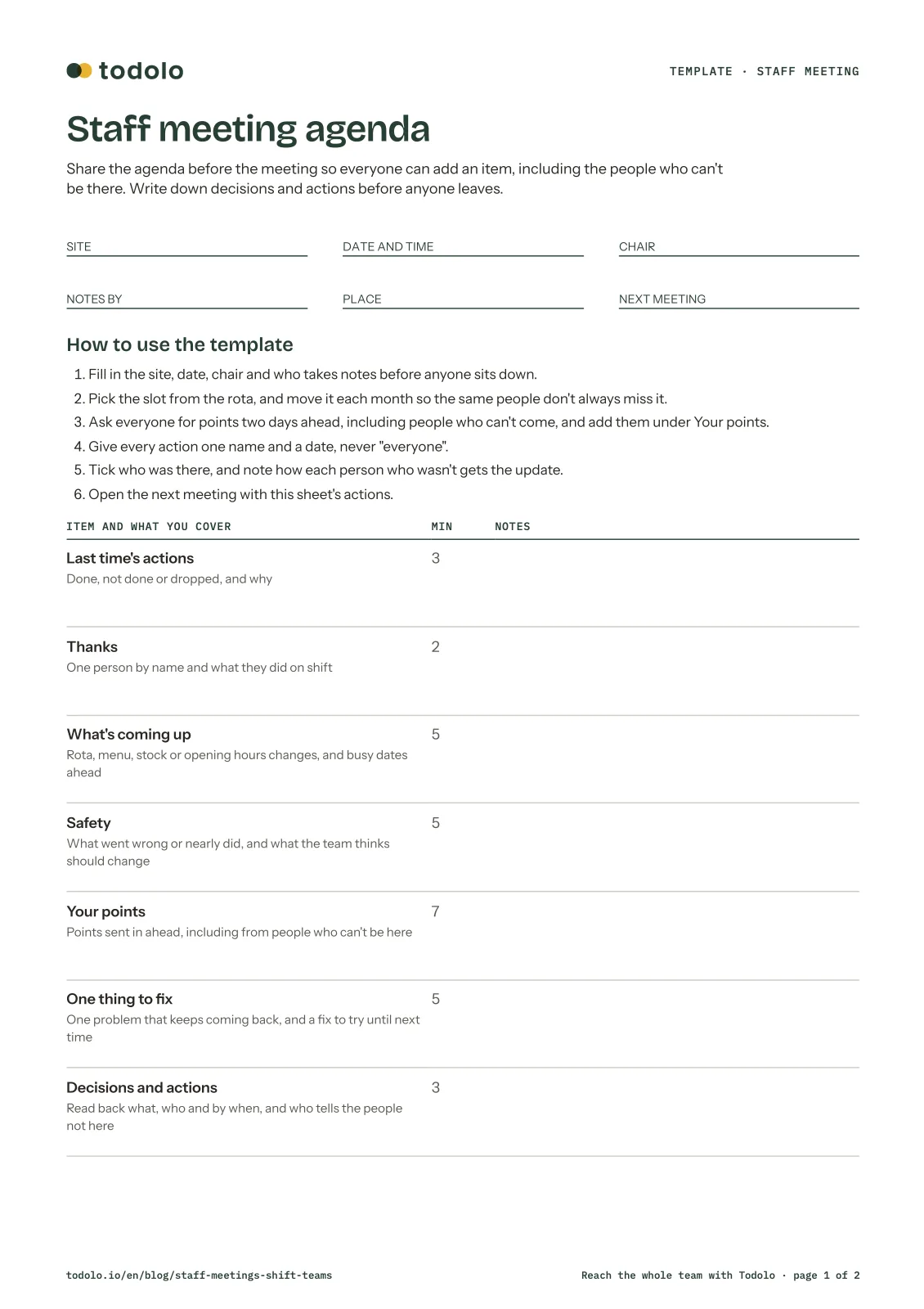
How to use the template
- Fill in the site, date, chair and who takes notes before anyone sits down.
- Pick the slot from the rota, and move it each month so the same people don’t always miss it.
- Ask everyone for points two days ahead, including people who can’t come, and add them under Your points.
- Give every action one name and a date, never “everyone”.
- Tick who was there, and note how each person who wasn’t gets the update.
- Open the next meeting with this sheet’s actions.
A 30-minute staff meeting agenda
| Item | Minutes | What you cover |
|---|---|---|
| Last time’s actions | 3 | Done, not done or dropped, and why |
| Thanks | 2 | One person by name and what they did on shift |
| What’s coming up | 5 | Rota, menu, stock or opening hours changes, and busy dates ahead |
| Safety | 5 | What went wrong or nearly did, and what the team thinks should change |
| Your points | 7 | Points sent in ahead, including from people who can’t be here |
| One thing to fix | 5 | One problem that keeps coming back, and a fix to try until next time |
| Decisions and actions | 3 | Read back what, who and by when, and who tells the people not here |
Thirty minutes is our suggestion, not a rule. Short on time? Cut what’s coming up and the one thing to fix, and put them in the written update. Never cut safety or the team’s points: they make it a meeting, not a briefing.
How to run a five-minute team huddle before a shift
A team huddle, or pre-shift huddle, is a short stand-up meeting at the start of a shift. Its purpose is the next few hours: who’s where, what’s different today and what could go wrong. We suggest five minutes, ten at most, in paid time.
Staggered starts are the hard part of any pre-shift meeting. If the kitchen starts at 10:00, the floor at 11:30 and the evening team at 17:00, huddle at each start, or once at the biggest overlap with a written note for later starters. In a hotel, the daily briefing across departments does the same job: see internal communication in hotels.
What to cover in a restaurant, hotel or shop
Pick three things, not ten:
- In a restaurant: covers and big bookings, what’s off the menu, allergens in new dishes, and who’s on which section.
- In a hotel: arrivals, departures and groups, rooms out of order, and anything the night shift handed over.
- In a shop: deliveries, offers that start today, and who’s covering the tills and fitting rooms.
On every site, add one safety point and one thing from the last handover.
Do staff get paid for staff meetings?
Yes, when your employer requires you to be there. In the UK, GOV.UK’s minimum wage guidance counts a team meeting as working time, and in the US, federal rules count a required, job-related meeting as hours worked. This is a practical guide, not legal advice.
In the UK
GOV.UK’s minimum wage guidance gives the example of a worker asked “to come to a 1-hour team meeting once a week, and to come in 30 minutes early each day to prepare for the shift ahead”. Both count as working time for the minimum wage, and that includes zero-hours staff: ACAS says employers must pay the National Minimum Wage “no matter how many hours are offered or worked”. Travel between home and work doesn’t count, unless someone works while travelling.
The Working Time Regulations 1998 define working time as any period when a worker is “working, at his employer’s disposal and carrying out his activity or duties”. A required meeting fits that, in our reading, so never hold one in someone’s break.
There’s no statutory minimum call-in pay in the UK today. The Employment Rights Act 2025 gives zero-hours and similar workers, not all staff, rights to reasonable notice of shifts and to pay for shifts cancelled, moved or cut short at short notice. They aren’t in force yet: the government’s roadmap puts them in 2027.
If you’re on shift: a meeting you’re told to attend, or a huddle before your start time, is paid time. If you’re the manager: put it on the rota, start the clock when the huddle starts, and pay for the time if someone comes in on a day off.
In the US
Under the Fair Labor Standards Act, meeting time can go unpaid only if all four tests in 29 CFR 785.27 are met: outside regular hours, in fact voluntary, not directly related to the job, and no productive work. A required meeting isn’t voluntary. Nor is one that staff are “led to believe” they’d suffer for missing (785.28). So a required staff meeting is hours worked.
The Department of Labor says the FLSA doesn’t require show-up pay, but some states do: California’s reporting time pay and New York’s call-in pay for hospitality are two.
Getting the update to every shift and every site
Nine people heard Amira at 16:45. The other 13 need the same update before their next shift, and a way to answer before anything’s final. One GM can manage that with a note by the rota and a lot of reminding. Ten sites can’t.
Todolo is one app for the whole shift: news, chat, training and handbooks in an employee app that needs no computer or company email address. Todolo Communications covers what happens around the meeting:
- The invite. A calendar event with RSVP, so you see who’s coming.
- The update. A feed post targeted by role and site, written ahead and pinned until the next meeting.
- Read confirmation. Important posts need a confirmation before they count as read, and you see who confirmed. That shows who read the update, not who took part or was consulted.
- The replies. Channels by site and role, where every message can be read in each person’s own language.
- The changed routine. Put it in the handbook, and TOD, Todolo’s AI teammate, answers questions from it mid-shift and points to where the answer came from.
- Between meetings. Pulse surveys in Todolo People show results by site, with answers stored without names and only shown once a group has enough of them, three by default.
ESS Group runs Todolo for more than 3,000 people in its hotels and restaurants, in five languages, and a post about tonight’s conference goes to the people working it and nobody else.
Todolo doesn’t run the meeting, write the minutes or build your rota. The slot still goes on the rota you already use, and the listening is still yours.
Common questions about staff meetings
What should be on a staff meeting agenda?
Seven items: last time’s actions, a thank you, what’s coming up, safety, the team’s own points, one recurring problem to fix, and the decisions and actions, read back with names and dates. On a shift team, add who wasn’t there and how they’ll get the update.
What is a team huddle?
A team huddle is a short stand-up with whoever’s on, at the start of a shift, about the hours ahead. You’ll also hear it called a pre-shift huddle, a pre-shift meeting or, in UK hotels and restaurants, the daily briefing.
Can my employer ask me to come in on a day off for a staff meeting?
They can ask, and if you go, it counts as working time for the minimum wage. UK law sets no minimum number of paid hours for coming in, so you’re owed the time you’re there, not a minimum shift. Can’t make it? Send your points ahead and ask for the update.
Should casual and zero-hours staff come to staff meetings?
Invite them, and pay them for the time if they come. Just don’t make the update depend on them being there: collect their points ahead, send them the update, and move the slot so the weekend casuals catch one.
Start with next week’s rota
Open next week’s rota, find the half hour when most of the team overlaps, and write down who that slot misses: the weekend team, the night shift, the casuals. Book the meeting, print the agenda, and plan their update first.
In thirty minutes we’ll show you how the invite, the update for everyone who wasn’t there and their replies would work in Todolo, site by site. There’s no long contract to sign, and there’s a 30-day money-back guarantee.