Guides & resources
Fire safety checklist for restaurants, hotels and shops: weekly and monthly checks, with a free log book (PDF)
A fire safety checklist for restaurants, hotels and shops: what UK law asks of the responsible person, weekly and monthly checks, and a free log book (PDF).
Short answer: A fire safety checklist is how the responsible person shows that the fire precautions in the building still work, week after week. In England and Wales the law is the Regulatory Reform (Fire Safety) Order 2005: you must carry out a fire risk assessment, keep the premises and the fire equipment “subject to a suitable system of maintenance” and train your staff when they start. Since 1 October 2023 every responsible person must record the risk assessment in full. In practice that means a weekly fire alarm test, a monthly walk round with a checklist, a log book that shows what was checked and fixed, and drills and training that are written down.
It’s a Saturday night in December. The restaurant is full, the Christmas menu is on and Priya, the GM, goes out the back for more ice. In front of the fire exit there are three boxes and a pallet of soft drinks from the afternoon delivery. Nobody put them there on purpose. It was just the only space left.
This guide is for GMs and managers in restaurants, pubs, hotels and shops, and the ops and area managers who look after several sites. It covers the law in England and Wales and isn’t legal advice. Scotland and Northern Ireland have their own rules. Keep the free fire safety checklist and log book (PDF) open while you read.
What is a fire safety checklist?
A fire safety checklist is a list of the fire precautions in your premises that someone walks round and checks on a fixed schedule: escape routes clear, fire doors shut, extinguishers in place, the alarm panel showing no faults. Each check is dated and signed, and anything wrong goes into the log book with what’s being done about it.
It isn’t the same as a fire risk assessment. The risk assessment decides what precautions you need. The checklist makes sure they’re still there and still work on a busy Saturday. You need both.
What does UK law say about fire safety in the workplace?
In England and Wales the law is the Regulatory Reform (Fire Safety) Order 2005, usually called the Fire Safety Order. It applies to almost all non-domestic premises, and that includes restaurants, pubs, hotels and shops.
The duties sit with the responsible person. According to GOV.UK, that’s the employer, owner, landlord, occupier or anyone else with control of the premises. Where there’s more than one, you must work together. If you run a restaurant in a unit you lease, both you and your landlord are likely to be responsible persons, each for your own part.
The local fire and rescue authority enforces the Order. Its inspectors can visit your premises and issue notices that require you to make changes. Serious breaches can lead to fines or prison.
What’s law and what’s guidance?
The Order is law. British Standards and fire service guidance aren’t law, but they’re what a competent fire risk assessor and an inspector will expect you to follow.
| What applies | Type | Source |
|---|---|---|
| Make a suitable and sufficient fire risk assessment | Law | Fire Safety Order, article 9 |
| Record the fire risk assessment in full, and your fire safety arrangements | Law | Article 9, as amended by section 156 of the Building Safety Act 2022 |
| Provide fire fighting equipment and fire detection where needed | Law | Article 13 |
| Keep escape routes and exits clear and usable | Law | Article 14 |
| Have procedures for serious and imminent danger, and drills | Law | Article 15 |
| Keep the premises and fire equipment under a suitable system of maintenance | Law | Article 17 |
| Train staff when they start and repeat it periodically, in working hours | Law | Article 21 |
| Test the fire alarm weekly and record it | British Standard | BS 5839-1 |
| Test emergency lighting monthly, with a full-duration test once a year | British Standard | BS 5266-1 |
| Have extinguishers serviced every year by a competent person | British Standard | BS 5306-3 |
| Walk round with a fire safety checklist every month | Good practice | Our suggestion |
Do I need a written fire risk assessment?
Yes. The rule used to be that only employers with five or more staff had to write it down. That changed on 1 October 2023. The GOV.UK guidance on section 156 says you “must now record the fire risk assessment in full (including all the findings)”, and record your fire safety arrangements too, whatever the size of the business. If someone else does the assessment for you, make sure they’re competent to do it.
How to run a risk assessment step by step is in our risk assessment template. The checklist below is what keeps it true between reviews.
Weekly and monthly fire safety checks
Article 17 doesn’t say how often. It says the premises and the equipment must be “subject to a suitable system of maintenance”. The British Standards fill in the detail for the systems most premises have, and the rest is good practice.
- Every shift: escape routes and fire exits clear and unlocked as part of opening and closing, and kitchen equipment switched off at close.
- Every week: test the fire alarm from a call point and write it in the log book. BS 5839-1 recommends a different call point each week, so that over time every one gets tested.
- Every month: test the emergency lighting with a short functional test, and walk round with the full checklist below.
- Every six months: a service of the fire alarm by a competent contractor, as BS 5839-1 recommends.
- Every year: a full-duration test of the emergency lighting, usually three hours, and a service of the extinguishers by a competent person. Write down when each was done.
Do the full-duration lighting test when the building is empty, or when you can manage without the emergency lights for the hours it takes them to recharge.
How to test a fire alarm weekly
- Tell the alarm receiving centre, if you have one, and warn staff and guests that you’re testing.
- Set off the alarm from this week’s call point with the test key.
- Check the sounders can be heard everywhere, including the cellar, the walk-in and the toilets.
- Reset the panel and check it shows no faults.
- Write the date, the call point, the result and your name in the log book.
Pick the same time each week, before service, so the test becomes a habit and doesn’t catch anyone out in the middle of a lunch rush.
Fire safety checklist template
These points are a starting point for restaurants, pubs, hotels and shops. Cross out what you don’t have and add what only you have, like smoke vents, a gas cylinder store or fire action notices in the bedrooms.
Escape routes and exits
- Escape routes and fire exits are clear, including the stockroom and the back yard
- Fire exits open easily from the inside without a key
- Fire exit signs are visible and lit
- Fire action notices are up and match the building as it is now
Alarm and emergency lighting
- The fire alarm panel shows no faults
- This month’s weekly alarm tests are written in the log book
- Emergency lighting works on the monthly test and no fittings are broken
- No detectors are covered, moved or removed
Extinguishers and fire blankets
- Extinguishers and fire blankets are in place, visible and easy to reach
- Extinguisher gauges are in the green and the tamper seals are intact
- The next service date on the extinguishers hasn’t passed
- Staff on shift know where the nearest extinguisher and fire blanket are
Kitchen and electrics
- The extraction canopy and grease filters are cleaned on schedule
- Fryers, hobs and ovens are switched off by the closing routine
- The electrical cupboard is clear and the door is shut
- No damaged cables and no adaptors plugged into adaptors
Storage and fire doors
- Fire doors are shut or close on their own, and nobody has wedged them open
- Nothing that burns is stored near heat, in stairways or on escape routes
- Bins and cardboard aren’t stacked against the building or by fire exits
- Gas cylinders and other flammables are stored the way your risk assessment says
Fire training and fire drills
Article 21 says staff must get adequate safety training “at the time when they are first employed”, again when the risks change, repeated periodically where appropriate, and during working hours. The Order doesn’t give intervals, so the ones below are our suggestion. Your fire risk assessment may say something different for your building.
Fire training and drill plan
| What | Who | How often |
|---|---|---|
| Fire safety in the induction: escape routes, assembly point, alarm and extinguishers | Every new starter, agency and seasonal staff too | Before their first shift alone |
| Hands-on training with extinguishers and fire blankets | Everyone who works shifts | Every two years |
| Fire drill | The whole site | At least once a year |
| How to run the weekly alarm test and the monthly check | Whoever does the checks | When someone new takes over |
| Fire safety as an item at the team meeting | Everyone | Twice a year |
| Review of the fire risk assessment, the log book and this plan | Responsible person and site managers | Once a year, and after any change |
The first row matters most in a sector with this many new faces. The staff induction is where fire safety reaches the person who starts on Friday, and seasonal staff need to know as much as someone who’s been there ten years. Put fire safety on the agenda of your team meetings before the Christmas season and before summer, when you have the most guests and the most new staff on shift.
Free fire safety log book (PDF)
The log book is a free PDF: download the fire safety checklist and log book (PDF). Page one is the checklist above with a box for every month, so a year fits on one sheet. Page two is the training and drill plan with a column for when each was last done, a log for the weekly alarm test and a table for faults and action.
No law requires this particular template, and it doesn’t do your fire safety for you. It doesn’t replace your fire risk assessment or the service a competent contractor does on the alarm, the lighting and the extinguishers.
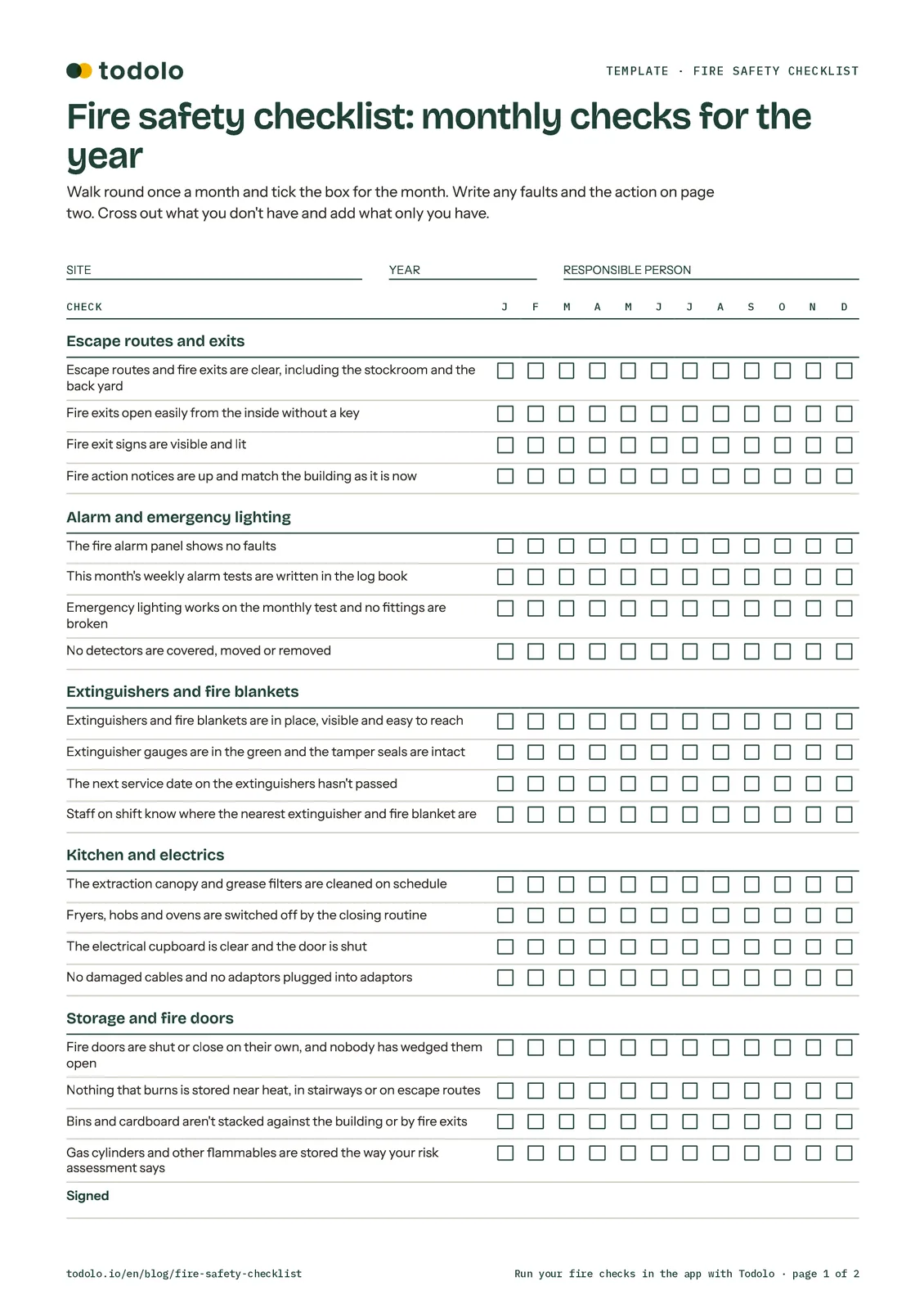
How to use the log book
- Fill in the site, the year and the responsible person.
- Cross out what doesn’t apply and add what’s yours.
- Keep it where the checks start, like the office or the staff room, next to the alarm panel if you can.
- Tick each point every month and write any faults in the table on page two.
- Log every weekly alarm test, and the dates of the last drill and training.
- Bring it to the annual review of your fire risk assessment, with the service reports.
Fire safety across several sites
Do what’s shared once, and what’s local where it happens. That’s our suggestion. The Order only says each set of premises must have its own risk assessment and precautions.
- The policy, roles and plans are written once, centrally, and apply to every site.
- The checks are done on site with the same checklist everywhere, plus whatever only that address has, like a gas cylinder store or a loading bay.
- Who does what is agreed per building, because every lease and every landlord is different. Write down which responsible person looks after the alarm, the sprinklers and the shared escape routes.
- Faults are collected in one place, so the person responsible can see which sites have open faults and how long they’ve been open.
Fire safety on shift with Todolo
Fire safety isn’t decided at the annual review. It’s decided when the afternoon delivery arrives and the fire exit is the only free space, when the fryer needs switching off after the last sitting and when someone new is on the pot wash on a Saturday. That’s where your team is, and that’s where the procedures need to be. Todolo is the app for the whole shift, an employee app where your staff get the news, chat, do their training and find the procedures.
The monthly fire check can become a checklist per location or area, with a QR code on the spot so whoever’s doing the round starts the right checklist where they’re standing. That’s how digital inspection rounds with QR codes work. Anyone who finds a fault reports it on their phone, on the checklist item or in a form, with a photo. The issue gets an owner and a due date. Read more about checklists, issues and workflows in Todolo Operations.
Evacuation and closing procedures go out in a post to the right sites and roles, and read confirmation shows who’s read them. If the procedure is in your handbook, your team can ask TOD, Todolo’s AI teammate, about it in the middle of a shift.
Todolo doesn’t have a ready-made fire safety module and doesn’t meet any legal duty for you. The risk assessment, the precautions and the responsibility stay with you and your landlord.
Fire safety checklist FAQs
Who is the responsible person for fire safety?
The employer, and anyone else with control of the premises, like the owner, landlord, occupier or a managing agent. If you lease your unit, you and your landlord are both likely to be responsible persons for your own parts of the building, and you must work together.
How often should a fire alarm be tested?
Weekly, from a different call point each time, as BS 5839-1 recommends, and recorded in the log book. The same standard recommends a service by a competent contractor at least every six months.
How often should emergency lighting be tested?
BS 5266-1 recommends a short functional test every month and a full-duration test, usually three hours, once a year. Write both in the log book.
Do I need a fire safety log book?
The Order doesn’t use the words log book, but you must keep the premises and equipment under a suitable system of maintenance and, since October 2023, record your fire safety arrangements. A log book is the simplest way to show an inspector that the checks, tests, drills and repairs actually happened.
How often should we have a fire drill?
At least once a year is the usual starting point, and more often if your fire risk assessment says so, like in a hotel with night staff or a site with high staff turnover. Write down when it happened, how long it took and what you’d do differently.
What’s the difference between a fire risk assessment and a fire safety checklist?
The risk assessment looks at the fire hazards, who’s at risk and what precautions you need, and you review it regularly and after changes. The checklist is the routine walk round that makes sure those precautions are still in place and working. The workplace safety inspection checklist covers the wider health and safety walk round.
Can Todolo do our fire safety for us?
No. You and your team do the fire safety, and the responsibility stays with you and your landlord. The app carries what happens between reviews: the check as a checklist, the fault reported with a photo and the fix followed up with an owner and a date.
Start with next week’s alarm test
You don’t have to write everything at once. Print the log book, do the weekly alarm test next week and the full walk round before the month ends, and write down what you find. Then name your responsible person on each site and put a date in the diary for the annual review.
In thirty minutes we’ll show you how your fire safety checks would look in Todolo, site by site. There’s no long contract, and you get a 30-day money-back guarantee.