Guides & resources
Training matrix template for restaurants, hotels and shops: who can do what on every shift (free PDF)
A training matrix template for shift teams: who can do what on every shift, a 0 to 3 scale, examples for restaurants, hotels and shops, and expiry dates. Free PDF.
Short answer: A training matrix, also called a skills matrix, is a table that shows who can do what. Your team goes down the side, the tasks and certificates go across the top, and each box says how well that person can do it. In a restaurant, hotel or shop it earns its keep shift by shift: is there someone on tonight who can cash up, take a chilled delivery properly or authorise an alcohol sale? UK law doesn’t ask for a matrix, but it does ask you to train people when they start and again when the risks change, and a matrix is the simplest way to know you have.
It’s Friday, quarter past five. Sophie is running the floor tonight, and Jamie, who always cashes up, has just called in sick. Can Priya do it? She thinks she did once, in August. Over the road the night manager is asking who’s been shown the fire panel, and in the shop on the corner nobody’s sure who’s allowed to take in the chilled delivery.
This guide is for GMs, store managers and shift leads, and the ops and area managers who look after several sites. It covers how to build the matrix, a scale that works for shift teams, and the skills that usually belong in it. It covers UK law and isn’t legal advice. Keep the free training matrix template (PDF) open while you read.
What is a training matrix?
A training matrix is one page that shows your team’s skills and training at a glance. People also call it a skills matrix or a competency matrix, and for a shift team they’re the same thing. Working out what everyone can do is a skills audit; the matrix is what the audit leaves behind.
In an office a skills matrix is often about careers and development. On a shift it’s about something more immediate: whether tonight can be staffed with the right people, whether one person is the only one who can do something, and who should learn what next.
Why a training matrix in hospitality and retail?
- You can staff the shift properly. When you build the rota you can see straight away whether tonight has someone who can close, take a delivery or deal with the fire alarm.
- You can see where you’re exposed. If only one person can do a task, the shift stalls the day they’re off. The matrix shows you before it happens.
- Training gets an order. You can see who learns what next, rather than fitting it in when it happens to be quiet.
- You can show what everyone’s had. When the EHO visits or head office audits the site, the answer is on one page rather than in your head.
- Casual staff show up. The people who work two Saturdays a month are easy to miss. In the matrix they sit on the same rows as everyone else.
What does UK law ask for?
No law says you need a training matrix. Several say your team has to be trained, and the matrix is how you keep track of it.
| What | What it means for the matrix | Where it is |
|---|---|---|
| Health and safety training | Training when people start and when they meet new or bigger risks, repeated where appropriate, in working hours | MHSWR 1999, regulation 13 |
| Food hygiene | Everyone who handles food is supervised and instructed or trained in food hygiene to match their work | Regulation (EC) 852/2004, Annex II, Chapter XII |
| Selling alcohol | Every sale is made or authorised by a personal licence holder, so the matrix shows who holds one on each shift | Licensing Act 2003, section 19 |
| First aid | Enough trained people on site to match your first-aid needs assessment | Health and Safety (First-Aid) Regulations 1981 |
| Fire safety | Adequate fire safety training for your team, which your fire safety checklist logs | Regulatory Reform (Fire Safety) Order 2005, article 21 |
The Food Standards Agency is clear that food handlers don’t need a food hygiene certificate by law. What you need is to show they’ve been trained for what they do, and the matrix does that. It doesn’t replace your staff induction or your health and safety management. It shows whether they’re working.
How to build a training matrix in five steps
1. Pick the skills
Start with what decides whether a shift works, not everything that could be learned. Ten to twelve columns per site goes a long way. Put the things everyone needs first, like fire safety and food hygiene, then the things only some people need, like cashing up or the night audit. Write each skill as something people do: “cash up the till”, not “till”.
2. Agree the scale
A scale from 0 to 3 is enough for most shift teams. More than four steps and two managers will score the same person differently. The scale is in the next section and at the top of the template.
3. Fill it in together
Don’t score people from the office. Ask them, ask whoever trained them and, most of all, watch them do it. Having read the procedure isn’t the same as doing it on a Saturday with a queue at the bar. Include everyone, casuals and the person coming back from leave in the spring too.
4. Count your cover
For each skill, count how many people are on 2 or 3. If there’s only one name in a column, you’ve found the next thing to train. Then go through the rota: does every shift have at least one, ideally two, who can do the things that matter? The template has a row at the bottom for cover.
5. Plan the training and keep it current
Write down who learns what, who trains them and by when. Update the matrix when someone starts or leaves, when you bring in a new procedure, and at least once a quarter. A matrix from last spring doesn’t tell you who can do it today.
The training matrix scale
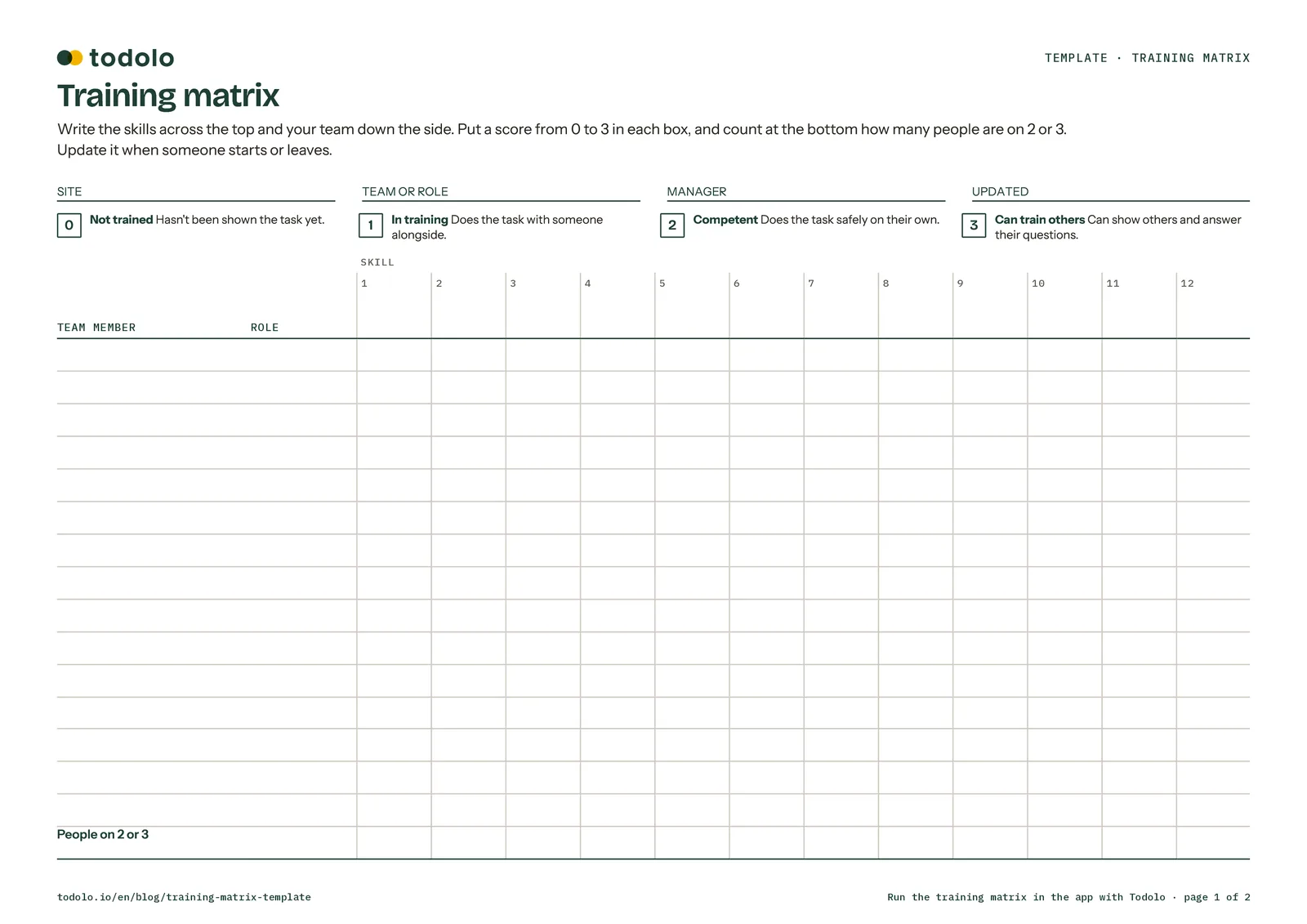
- 0 Not trained. Hasn’t been shown the task yet.
- 1 In training. Does the task with someone alongside.
- 2 Competent. Does the task safely on their own.
- 3 Can train others. Can show others and answer their questions.
Only score a 2 once you’ve seen someone do it on their own. That’s the level that decides whether a shift can be staffed, so it’s the one you count for cover.
Training matrix template
The template is a free two-page PDF: download the training matrix template (PDF). Page one is the matrix itself, with room for fifteen people and twelve skills, the scale at the top and a cover row at the bottom. Page two has a training plan, a log for training and certificates that expire, and the examples below to pick your columns from.
Example skills for restaurants, hotels and shops
Pick the columns that fit your site and cross out the rest. The examples are on page two of the template too.
Restaurants and pubs
- Open and close the kitchen to the procedure
- Food safety checks: temperatures and deliveries
- Allergens and labelling
- Fryer, oil change and cleaning
- Till and cashing up
- Personal licence and age checks
- First aid
- Fire alarm, extinguishers and evacuation
Hotels
- Check-in and check-out
- Night audit and lone working
- Housekeeping and room checks
- Breakfast service and allergens
- Keys, key cards and lost property
- Fire panel and guest evacuation
- First aid
- Handling aggression at the desk
Shops
- Open, close and set the alarm
- Till, refunds and cashing up
- Deliveries and the cold chain
- Age-restricted sales
- Theft and robbery
- Pallet truck and roll cages
- First aid
- Fire alarm, extinguishers and evacuation
Training and certificates that expire
Some boxes in the matrix aren’t a level, they’re a date. First aid, a personal licence refresher or your own allergen quiz often only counts for a while, by the course’s rules or your own. Write down when the training was done and when it’s due again, and book the next one before the last one runs out. The log on page two of the template is there for that.
Go through the log whenever you update the matrix. Anything that expires in the next three months, book now rather than when it’s already lapsed.
One training matrix across every site
In a group it’s tempting to let each site keep its own. You end up with as many scales as managers, and nobody can compare. Split it instead:
- Same columns for the same role. The kitchen matrix has the same skills in Leeds as in Bristol, on the same scale.
- Each site fills in its own. Only the manager on the floor has seen who copes on a Friday night.
- Compare cover. Which site has only one person who can close, and who from the next site along could cover?
Common training matrix mistakes
- Too many columns. Forty skills and nobody keeps it up. Start with ten.
- The manager’s guess. A score nobody has seen in practice is worth about as much as no score.
- It’s never updated. Last year’s matrix shows who’s left, not who can.
- Casual staff are missing. They’re often the ones on their own on a Sunday in July.
- It turns into a grade. The matrix shows what the shift needs, not how good someone is. Development is for the one-to-one.
The training matrix in the app with Todolo
Todolo is the one app your team opens for the whole shift, so training sits next to everything else they use.
- An induction per role. In People you build learning paths with courses and quizzes people do on their phone, in their own language.
- Who knows what. You track results per person and see who needs to retake a quiz. Course certificates are internal, not official qualifications.
- Certifications that don’t quietly lapse. Set an expiry date and Todolo reminds you before it runs out.
- Their account is ready before day one. Add a new starter in Planday, Caspeco or Personalkollen and they get a Todolo account automatically, in the right site with the right permissions.
- Answers without asking a colleague for the third time. TOD answers from your own handbooks and procedures, in the language the question was asked in.
In thirty minutes we’ll show you how training for each of your roles would look in Todolo, site by site, ideally before your seasonal staff start. There’s no long contract, and you get a 30-day money-back guarantee.
Common questions about training matrices
What’s the difference between a training matrix and a skills matrix?
For a shift team, nothing. Some companies use training matrix for courses and certificates and skills matrix for what people can actually do. On the shop floor you want both in one place, so the template covers both.
How many skills should a training matrix have?
As few as you can get away with. For one restaurant, hotel or shop, ten to twelve is usually enough, picked by what decides whether a shift works. If you need more, keep one matrix per team, say kitchen and front of house.
How often should you update it?
When someone starts or leaves, when you bring in a new procedure, and at least once a quarter. Check what’s about to expire at the same time.
Is a training matrix a legal requirement?
No. What the law asks is that people get adequate training when they start and when the risks change (regulation 13 of MHSWR 1999), and that food handlers are trained or instructed in food hygiene. A matrix is how you know you’ve done it.
Should the team see the matrix?
Yes, it usually helps. Someone who can see their own row knows what to learn next. Names and scores are personal data, though, so keep to what you need to staff shifts and keep it about tasks, not opinions of people.
Start with the next rota
You don’t have to audit the whole group today. Print the template (PDF), pick ten skills for your site and fill it in with your shift leads before the next rota goes out.