Guides & resources
Running Multi-Site and 24/7 Operations Across Time Zones
Run multi-site and 24/7 operations across time zones: follow-the-sun models, shift handover routines, a practical checklist, and consistent daily execution.
Running Multi-Site and 24/7 Operations Across Time Zones
Most advice about time zones is written for office teams: when to schedule meetings, how to run async stand-ups. That is not the problem in operations.
If you run production sites, hotels, support desks, or facility teams in more than one time zone, the real questions are different. Did the night shift finish the routines? Who owns the incident that was reported at 03:40? Does the site in another country actually work the way the playbook says?
This guide covers the operational side: follow-the-sun coverage, shift handovers that hold up in practice, and how to keep routines consistent when nobody can look over anyone’s shoulder. At the end you will find a handover checklist you can copy and answers to the most common questions.
Why time zones break operations, not just meetings
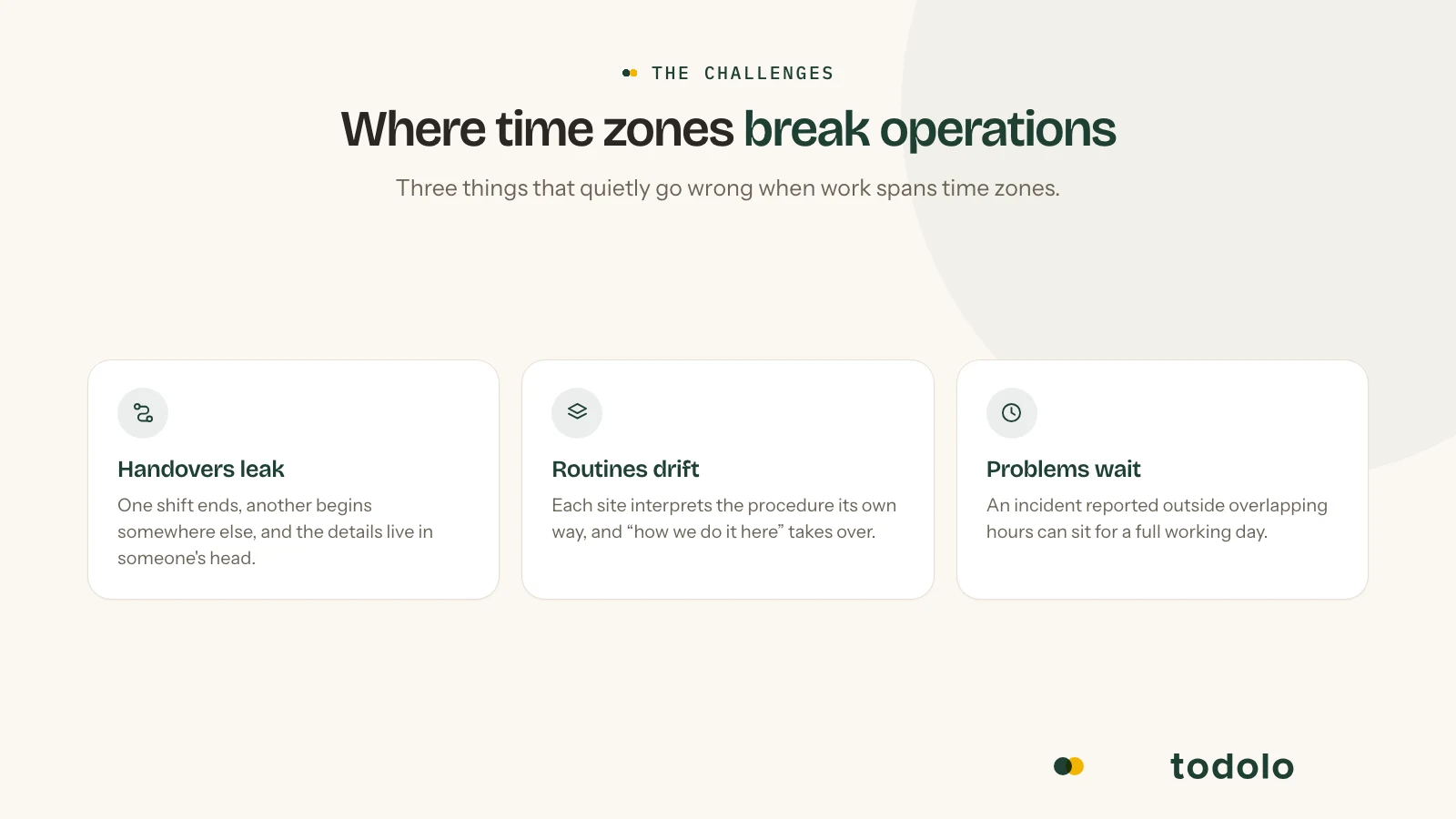
When work spans time zones, three things quietly go wrong:
-
Handovers leak. One shift ends, another begins somewhere else, and the details live in someone’s head, a half-written note, or a chat message nobody pinned. The next team starts blind.
-
Routines drift. Each site interprets the procedure its own way. Without shared checklists and follow-up, “how we do it here” replaces “how we do it.”
-
Problems wait. An incident reported outside overlapping hours can sit for a full working day before the right person even sees it.
None of these are fixed by scheduling better meetings. They are fixed by structure: clear routines, documented handovers, and visibility that does not depend on being awake at the same time.
What is a follow-the-sun model?
Follow-the-sun means work is handed from one time zone to the next as each team ends its day, so coverage continues around the clock without night shifts everywhere. It is the standard model for global support desks, IT operations, monitoring, and increasingly for production and facility management.
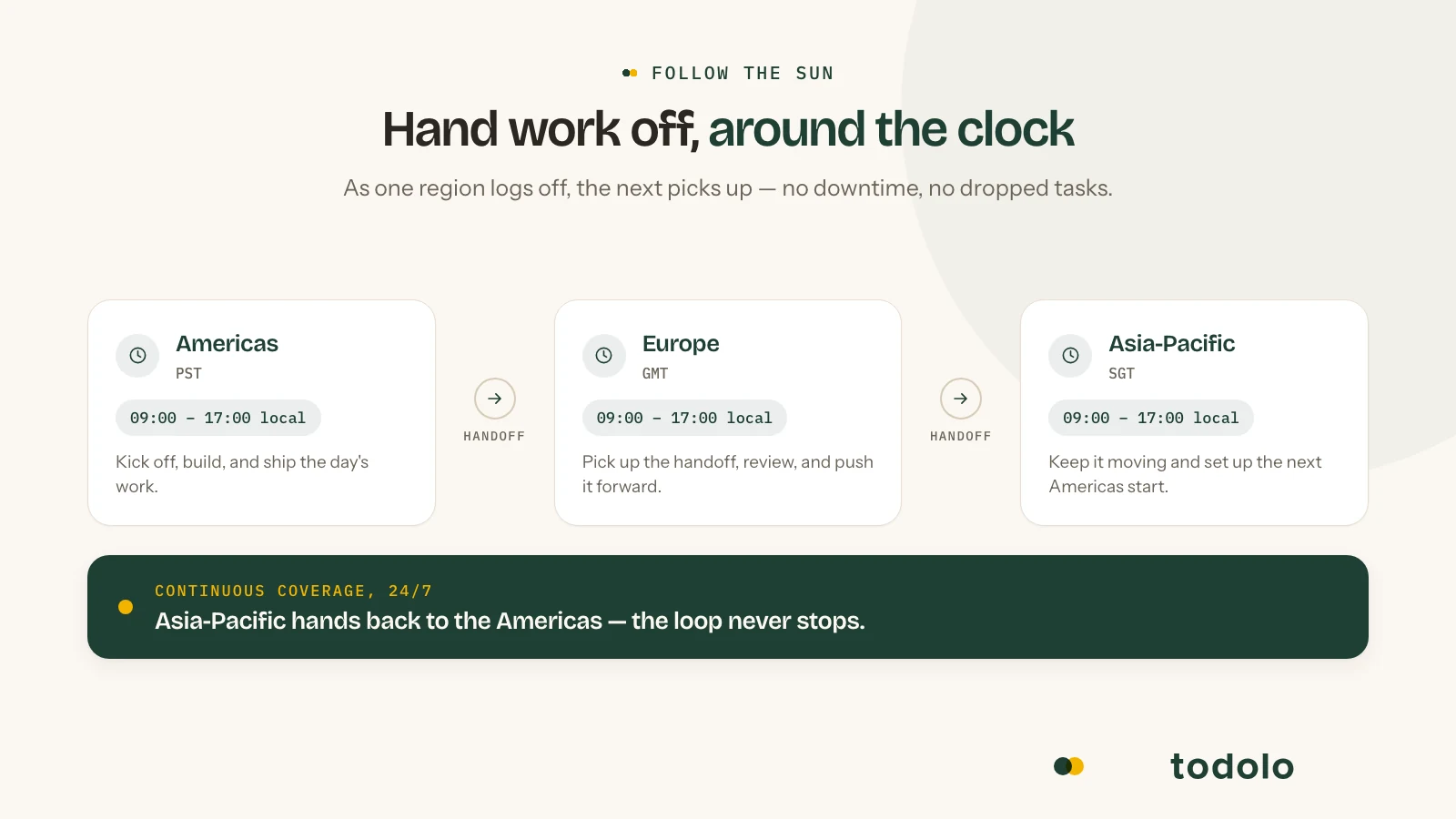
It works when three conditions are met:
-
Each team can see the current state of work the moment they start: what is done, what is open, what is urgent.
-
Handovers are structured and mandatory, not an optional courtesy message.
-
Routines are the same everywhere, so any team can pick up any task without translation.
If any of the three is missing, follow-the-sun becomes follow-the-confusion: every morning starts with reconstruction instead of execution.
How to structure shift handovers across time zones
A reliable handover is written, structured, and owned. Three principles:
-
Make it asynchronous by default. Teams in different time zones rarely overlap, so the handover must stand on its own without a conversation. A live call is a bonus, never the carrier of critical information.
-
Standardize the format. When every handover answers the same questions in the same order, the receiving team scans it in a minute. Free-text notes hide exactly the details that matter.
-
Give it an owner and a confirmation. One named person completes the handover, and the receiving shift confirms it. Unconfirmed handovers are how incidents disappear between shifts.
The internal communication patterns that work in hotels apply to any shift-based operation: information has to survive the person leaving the building.
The shift handover checklist
A handover template you can use as is, whether between shifts on one site or between sites in different time zones:
-
Routine status. Which scheduled checklists and recurring tasks were completed, and which were not, with reasons.
-
Open incidents and deviations. What happened, current status, and who owns each item.
-
Exceptions. Anything that deviated from normal: equipment behaving oddly, staffing gaps, supplier issues.
-
Priorities for the next shift. The two or three things that must happen first.
-
Pending decisions. Questions waiting for an answer, and who is expected to answer them.
-
Environment and equipment notes. Anything the next team needs to know about the physical state of the site.
-
Contacts. Who to reach, and how, if something escalates outside normal hours.
-
Confirmation. The receiving shift acknowledges the handover, with a timestamp.
Run this on paper and it works once. Run it as a digital checklist and every handover is logged with who completed what and when, which is precisely what you need when something goes wrong at 03:40 and the follow-up happens two time zones away.
Keeping routines consistent across sites
Consistency across time zones is not a communication problem; it is an execution problem. What works:
-
One set of SOPs, used everywhere. Write procedures once, keep them current, and make them easy to follow in daily work rather than stored in a folder. Local variation should be a deliberate decision, not an accident.
-
Scheduled checklists per site and shift. The same routine, scheduled in each site’s local time, with completion visible centrally. Managers see across all sites in the morning what actually happened overnight.
-
Deviations reported at the source. When something breaks at 02:00, the person on shift logs it immediately with photos and notes. The owner picks it up when their day starts, with full context instead of a secondhand summary.
-
Training that travels. New staff in every location go through the same onboarding, so “the way we work” is defined by the company, not by whoever happened to train them.
Communication that works asynchronously
Multi-site teams cannot rely on real-time conversation, so the fundamentals matter more:
-
Agree on response expectations: what needs an answer within the hour, and what can wait a working day.
-
Keep operational communication in structured channels tied to the work, not in private threads that vanish with the person.
-
Document decisions where the next shift will look, not where the current shift happened to be chatting.
-
Put everything on mobile. In operations, the people who need the information are on the floor, not at a desk.
What actually helps, tool-wise
You need surprisingly little: shared scheduled checklists, a structured handover flow, incident reporting with ownership, communication attached to the work, and an execution log a manager can read across sites. That is one operations platform, not five disconnected tools.
This is the problem Todolo is built for: routines, handovers, deviations, communication, and training in one app, with local-time scheduling per site and central visibility across all of them. The night shift completes the checklist in their morning; you read the log in yours.
Frequently Asked Questions
What is a follow-the-sun operating model?
Follow-the-sun is a way of organizing work so it passes from one time zone to the next as each team finishes its day, giving continuous coverage without night shifts in every location. It requires shared visibility of work status, structured handovers, and identical routines across teams.
What should a shift handover include?
A complete handover covers routine completion status, open incidents with owners, exceptions from the normal day, priorities for the incoming shift, pending decisions, equipment or environment notes, escalation contacts, and a confirmation from the receiving team. A standardized digital checklist keeps the format consistent and the history traceable.
How do you keep routines consistent across sites in different time zones?
Use one shared set of SOPs, schedule the same checklists in each site’s local time, track completion centrally, and have deviations reported at the source as they happen. Consistency comes from shared execution and follow-up, not from more meetings.
How much overlap do teams in different time zones need?
Less than most organizations assume, if handovers are structured. A short overlap helps for escalations and relationship building, but a written, confirmed handover carries the operational load. Teams with zero overlap can run reliably when the handover routine is mandatory and logged.
The bottom line
Time zone spread is not the problem; unstructured work is. Operations that run on clear routines, confirmed handovers, and visible execution work as well at three sites in three countries as they do on one floor. Operations that run on memory and goodwill break as soon as the sun moves.
Want to see what structured handovers and cross-site visibility could look like in your operation?
Talk to us about running operations across time zones
Coordinating ops across time zones?
In 20 minutes we’ll cover how clearer routines and follow-up reduce mix-ups when teams don’t share the same clock.